
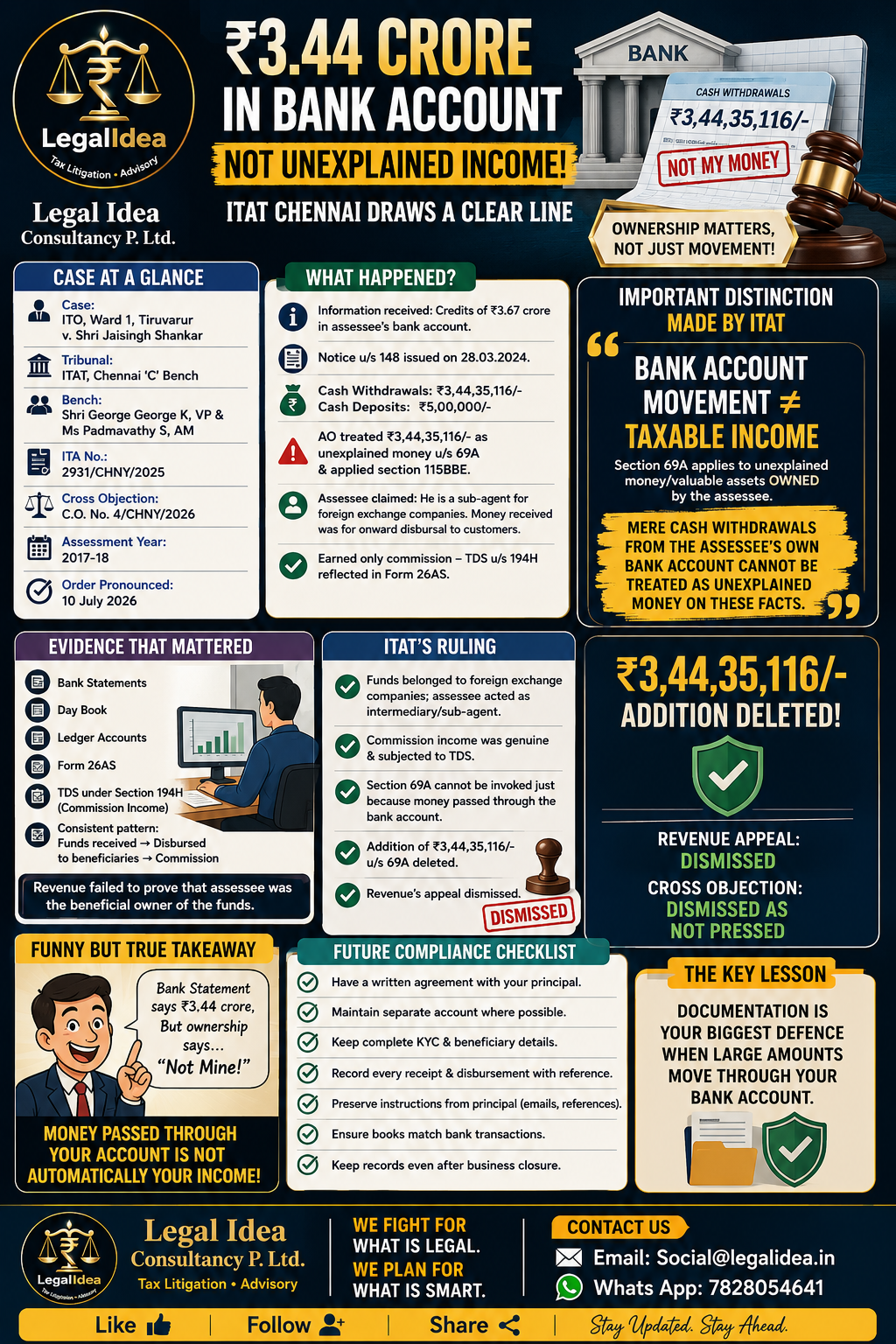
Income Tax Officer, Ward 1, Tiruvarur v. Shri Jaisingh Shankar
A significant ITAT Chennai ruling on whether large-value bank transactions can automatically be treated as the taxpayer's unexplained money under Section 69A.
Parties
Appellant
Income Tax Officer, Ward 1, Tiruvarur
Respondent / Cross Objector
Shri Jaisingh Shankar
Cross Objection
C.O. No. 4/CHNY/2026
Facts & Core Issue
The assessee had not filed his return of income under Section 139(1) for AY 2017-18.
The Department received information regarding credits aggregating to approximately ₹3.67 crore in the assessee's bank account.
A notice under Section 148 was subsequently issued on 28 March 2024.
Bank Transactions Examined
Cash Withdrawals
₹3,44,35,116
Cash Deposits
₹5,00,000
Information Received
Bank credits of approximately ₹3.67 crore
Assessee's Explanation
The assessee explained that he was working as a commission agent / sub-agent for foreign exchange entities.
According to him, the funds passing through his bank account were meant for onward disbursement to customers after KYC verification.
He claimed that he was merely an intermediary and that his actual earnings were limited to commission income.
Documentation became the problem
Complete details of ultimate beneficiaries, including names, PANs, email IDs and supporting instructions from foreign exchange entities could not be produced. The assessee stated that the business had subsequently closed and records were not readily available.
Assessment Officer's View
₹3,44,35,116 was treated as unexplained money under Section 69A.
Section 115BBE was also applied to the addition.
What Happened in First Appeal?
Before the First Appellate Authority, the assessee produced:
The FAA found that the assessee was functioning as an authorised sub-agent/intermediary for foreign exchange companies.
The funds were received for onward disbursement to beneficiaries, while the assessee earned commission.
Importantly, Form 26AS reflected commission income on which TDS had been deducted under Section 194H.
The FAA therefore held that the assessee was not the beneficial owner of the funds and deleted the ₹3.44 crore addition.
Documentary Trail Considered
Foreign Exchange Entities
Funds received
Assessee's Account
Funds routed through intermediary
Beneficiaries
Funds disbursed onward
Commission income → TDS under Section 194H → Reflected in Form 26AS
ITAT's Important Findings
Consistent Transaction Pattern
The Tribunal noted the pattern of funds being received from foreign exchange entities and subsequently disbursed to beneficiaries.
Commission Income Was Reflected
Commission income was subjected to TDS under Section 194H and was reflected in Form 26AS.
Beneficial Ownership Not Established
The Revenue did not produce material showing that the assessee was the beneficial owner of the funds.
Bank Routing Is Not Ownership
Money routed through a bank account cannot simply be treated as the taxpayer's unexplained money without establishing ownership.
🔥 The Important Distinction
BANK ACCOUNT MOVEMENT ≠ TAXABLE INCOME
The real question is not merely how much money moved through the account — but whose money it actually was.
Section 69A — Why It Mattered
Section 69A deals with unexplained money, bullion, jewellery or other valuable articles found to be owned by the assessee.
In the context of the bank transactions examined in this case, the Tribunal observed that invoking Section 69A merely against cash withdrawals from the assessee's own bank account was misplaced on the facts of the case.
₹3.44 Crore
Moved through the bank account
₹3.44 Crore
Belonged beneficially to the taxpayer
Judgment & Directions
₹3,44,35,116 Addition Did Not Survive
- The ITAT upheld the FAA's deletion of the ₹3,44,35,116 addition under Section 69A.
- The Revenue's grounds were dismissed.
- The assessee's cross-objection challenging reopening under Section 148 was not pressed and was dismissed on that ground.
Revenue's Appeal
DISMISSED
Assessee's Cross Objection
DISMISSED
Section 69A Addition
Did not survive
Bank statement says: ₹3.44 crore.
Taxpayer says: “Not mine.”
AO says: “Then explain it.”
And honestly, that is where the real tax planning begins.
A bank account is not a tax return.
But if ₹3.44 crore is moving through your account and your documentation says only ₹3 lakh is your commission income, you better have the paperwork to prove the difference.
“It passed through my account” is not a defence by itself.
Equally, “It appeared in your bank account” does not automatically prove that you owned it.
The difference is evidence.
Future Planning / Client Guidance
Written Agency / Sub-Agency Agreement
Do not rely only on an oral understanding.
Separate Bank Account
Where commercially and legally appropriate, maintain a clearly identifiable account for client/principal funds.
Principal-Wise Reconciliation
Trace every receipt to Principal → Customer/Beneficiary → Amount → Date → Purpose.
KYC Records
Preserve the KYC trail wherever customer verification forms part of the business model.
Beneficiary Details
Keep names, transaction references and supporting documents.
Principal's Instructions
Retain emails, transaction instructions, payment instructions and related records.
Books Must Tell the Same Story as the Bank
If the bank statement and ledger tell different stories, the assessment problem starts there.
Preserve Records After Business Closure
Closing the business does not eliminate the need to preserve records supporting past transactions.
If your account is only a highway for someone else's money, keep enough evidence to prove who owns the vehicles travelling on it.
ITA No. 2931/CHNY/2025 | C.O. No. 4/CHNY/2026 | AY 2017-18 | Pronounced: 10 July 2026
Prepared for tax and legal awareness purposes. The case-specific facts, findings and directions should be read with the complete order before relying upon them in litigation.

Comments
2