
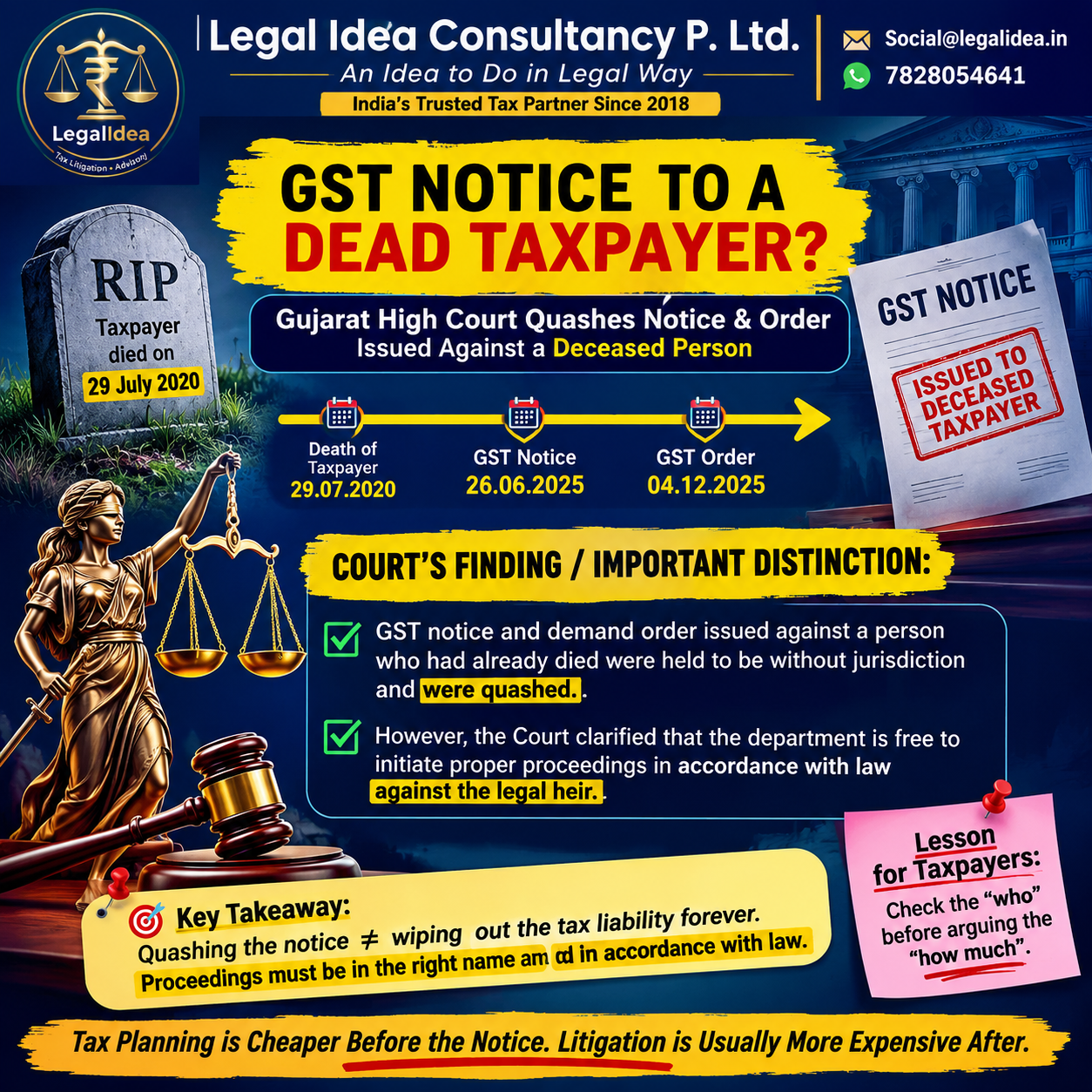
Can GST Proceedings Be Started Against a Dead Person?
Gujarat High Court quashes a GST notice and order issued against a proprietor who had died years before the proceedings began — while leaving the Department free to proceed against the legal heir in accordance with law.
1. Parties
Shahedabegum Irshadahmed Chaudhary
Legal Heir of deceased Irshadahmed Chaudhary.
State of Gujarat & Anr.
State tax authorities.
2. Facts of the Case
The deceased, Shri Irshadahmed Chaudhary, was carrying on the business of trading in metal scrap through his proprietorship concern:
IDEAL STEEL CORPORATION
GSTIN: 24AERPC6697J1ZW
At the time of cancellation, nil demand was assessed, with the cancellation being connected with failure to file GST returns for a continuous period of six months.
The petitioner, his wife, was a housewife and stated that she was not connected with the business and did not have access to the rented business premises or business records.
3. Then Came the GST Demand
FORM GST DRC-01A
Pre-show-cause intimation was issued in the name of the deceased proprietor.
Proposed liability: ₹21,49,414 + interest + penalty for FY 2018-19.
Section 74(1) Notice + FORM GST DRC-01
The notice was again issued in the name of the deceased taxpayer.
GST Order + FORM GST DRC-07
The Department passed the order against the deceased proprietor, who had died almost five years earlier.
Legal Heir Learnt About the Proceedings
The petitioner stated that she came to know about the proceedings only after a departmental officer called and informed her about the notice and order appearing on the GSTN portal.
Death Disclosed to the Department
The petitioner submitted an affidavit informing the State Tax Officer about her husband's death and produced the death certificate.
4. Core Legal Issue
Can GST proceedings under Section 74 be initiated and concluded against a person who was already dead when the notice was issued?
The petitioner relied upon Section 74(1), which permits the proper officer to issue notice to the “person chargeable with tax”.
She also relied upon the definition of “person” under Section 2(84) and argued that, in the case of a proprietorship, the relevant person is the individual proprietor.
The proprietor had died on 29 July 2020, whereas the notice was issued on 26 June 2025 and the order on 4 December 2025.
5. What Did the Department Say?
According to the judgment, the learned AGP appearing for the State was not in a position to controvert the factual position that both the notice and the order had been issued against a dead person.
The factual position was therefore effectively undisputed.
6. 🧑⚖️ Court's Finding
Death in 2020
The proprietor had died on 29 July 2020.
Registration Already Cancelled
GST registration had been cancelled on 3 March 2021.
Business Not Continued
The business was not continued after the proprietor's death.
Notice Issued in 2025
The impugned notice was issued nearly five years after death.
Order Also in Deceased's Name
The final order dated 4 December 2025 was also issued against the deceased proprietor.
Proceedings Quashed
The Court held that the notice and order could not survive.
7. 🔥 The Most Important Distinction
QUASHING THE PROCEEDING ≠ DELETING THE TAX LIABILITY FOREVER
The High Court quashed the notice dated 26.06.2025 and the order dated 04.12.2025 because they were issued against a person who had already died.
However, the Court expressly left it open to the respondents to initiate proper proceedings in accordance with law against the petitioner/legal heir.
⚠️ Don't Misread the Judgment
❌ Dead taxpayer = GST demand completely cancelledThat is not the correct takeaway from the judgment.
✅ Proceedings against deceased quashed; lawful proceedings against legal heir remain openThe procedural defect was fatal to the impugned notice and order, but the judgment does not amount to a blanket declaration that the underlying tax liability can never be recovered.
8. 🎯 Final Outcome
PROCEDURAL BATTLE WON — TAX LIABILITY NOT FINALLY EXTINGUISHED
- GST notice dated 26.06.2025 — QUASHED.
- GST order dated 04.12.2025 — QUASHED.
- Writ petition — ALLOWED.
- Department remains free to initiate proper proceedings against the legal heir in accordance with law.
9. Why This Judgment Matters to Taxpayers
GST proceedings do not become valid merely because they appear on the GST portal.
If the taxpayer was already dead when the notice itself was issued, the validity of the proceeding becomes a serious jurisdictional issue.
But legal heirs should not simply ignore tax notices relating to a deceased person.
10. Check the Chronology First
Date of Death
Establish the exact date of death from the death certificate.
Date of GST Notice
Check when the notice was issued and in whose name.
Date of Order
Verify whether the order was passed before or after death.
GST Registration Status
Check cancellation date and status of the registration.
Was Business Continued?
Establish whether the business continued after the proprietor's death.
Who Was Named?
Check whether proceedings were issued against the deceased or the legal heir.
11. 📂 Practical Compliance File for Legal Heirs
Death Certificate
Preserve the official record of death.
GST Cancellation Order
Keep the GST registration cancellation record.
Last GST Returns
Maintain the final filed GST returns and acknowledgements.
Income-Tax Records
Keep relevant ITRs and tax records.
Tax Notices
Preserve every GST and Income-tax communication.
Business Closure Documents
Maintain records showing whether the business continued.
Bank & Accounting Records
Preserve records relevant to outstanding liabilities.
Assets & Liabilities
Maintain a clear record for succession and tax proceedings.
Communication with Authorities
Keep affidavits, emails, portal submissions and acknowledgements.
A five-minute chronology can sometimes be more useful than a 50-page reply.
When a notice arrives after the death of a proprietor, first establish the basic timeline: Death → Registration Status → Notice → Order → Knowledge
If a GST notice arrives in the name of a deceased person, don't ignore it.
Immediately verify the name, GSTIN, date of death, date of notice, date of order and whether the proceedings were addressed to the deceased or the legal heir.
The Gujarat High Court judgment shows that these basic procedural facts can make a significant difference.
High Court of Gujarat at Ahmedabad | R/Special Civil Application No. 10294 of 2026 | Judgment dated 28 July 2026
Neutral Citation: 2026:GUJHC:47521-DB
Prepared for GST and tax-law awareness purposes. The key distinction is between quashing proceedings issued against a deceased person and extinguishing the underlying tax liability.

Comments
2