
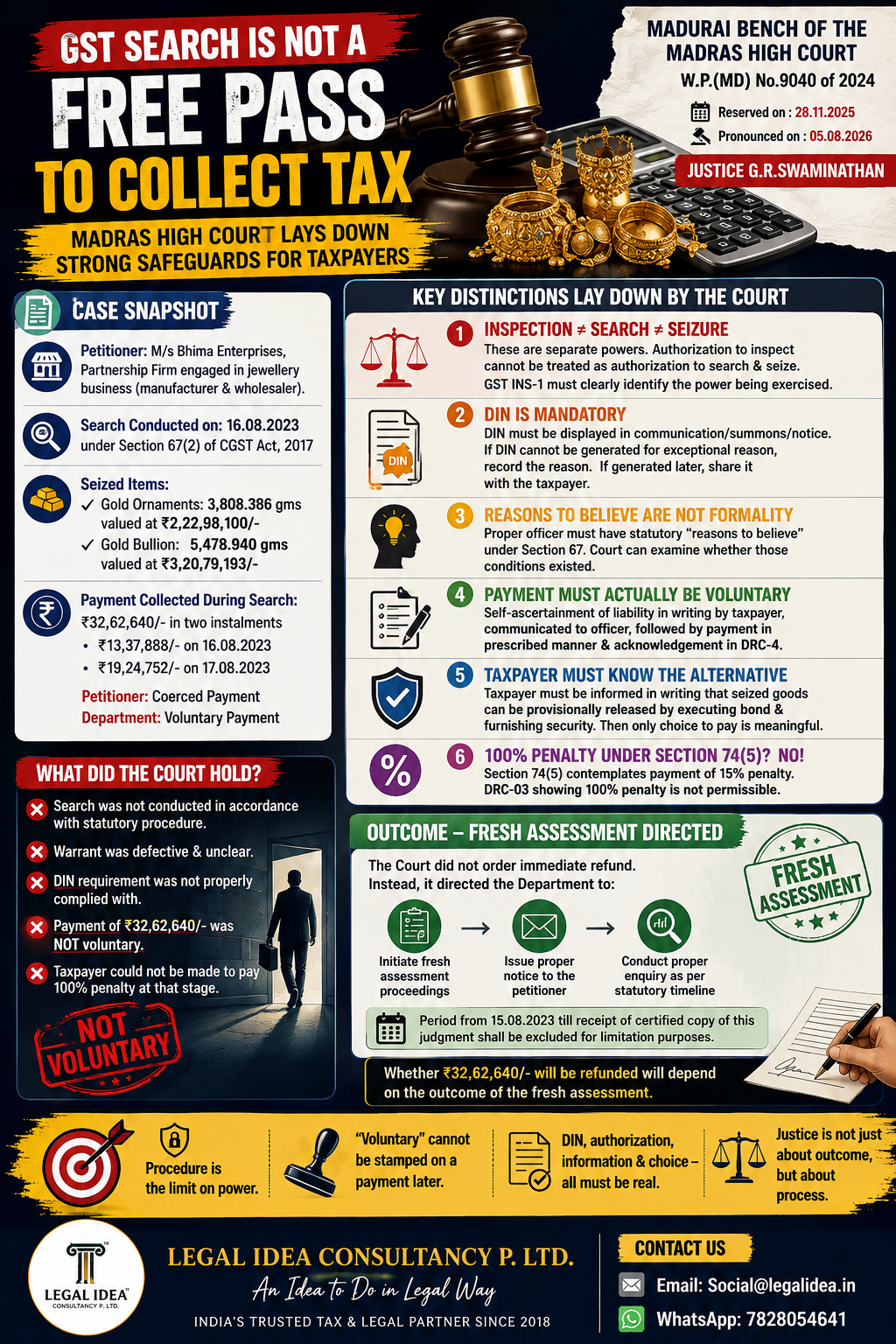
M/s Bhima Enterprises v. Principal Chief Commissioner of GST
A significant ruling on GST search, seizure, DIN compliance, voluntary payment and the limits of Section 67 powers.
Brief Summary
The case concerns the manner in which GST authorities exercise their powers of inspection, search and seizure and the validity of tax payments allegedly made voluntarily during such proceedings.
The Madras High Court examined whether the search authorization, DIN compliance and payment proceedings followed the statutory safeguards prescribed under the CGST Act.
Parties
Petitioner
M/s Bhima Enterprises — a partnership firm engaged in jewellery business, including manufacturing and wholesale activities.
Respondents
Principal Chief Commissioner, Commissioner, Joint Commissioner, Superintendent and Inspector of Central GST & Excise.
What Happened?
GST authorities conducted a surprise search at the petitioner's premises on 16 August 2023 under Section 67(2) of the CGST Act.
During the proceedings, the authorities alleged excess stock of gold ornaments and bullion and seized the following goods:
🪙 Gold Ornaments
⬡ Gold Bullion
⚠️ Payment Dispute
The petitioner claimed that ₹32,62,640 was collected during the search proceedings. The Department described the payment as voluntary; the petitioner alleged coercion.
Main Issues Before the Court
Court’s Important Findings
Inspection ≠ Search ≠ Seizure
The Court drew a clear distinction between the three powers. An authorization to inspect cannot automatically be treated as authorization to search and seize.
DIN Is Not a Mere Formality
The Document Identification Number must be displayed in communications, summons or notices. If it cannot be generated for an exceptional reason, the reason must be recorded.
Search Powers Cannot Be Mechanical
The proper officer must actually have the statutory “reasons to believe” required under Section 67. Judicial review can examine whether those conditions existed.
Payment Must Actually Be Voluntary
A payment cannot become voluntary merely because the document describes it as “voluntary”. The statutory process must support the taxpayer's self-ascertainment of liability.
Provisional Release Must Be Explained
Where goods are seized, the taxpayer should be informed in writing about provisional release against bond and security.
Words Alone Do Not Make Payment Voluntary
The basis of the taxpayer's self-ascertainment should be recorded in the taxpayer's own words rather than merely labelling the payment as voluntary.
Inspection, Search & Seizure Are Different Powers
The Court emphasized that the nature of the power being exercised must be clear from the authorization. An authorization for inspection cannot automatically become a warrant for search and seizure.
The GST INS-1 authorization must clearly identify the nature of power being exercised.
💡 What Makes a Payment “Voluntary”?
The Court emphasized that a Section 74(5) payment should follow the statutory process rather than simply being described as voluntary.
⚠️ 100% Penalty Under Section 74(5)?
The Court specifically flagged the penalty reflected in the DRC-03. At the Section 74(5) stage, the Court observed that the applicable penalty contemplated was 15%, not 100%.
Judgment / Final Outcome
The Court found significant procedural defects in the search and payment proceedings.
- The search was not conducted in accordance with the statutory procedure.
- The warrant was defective and unclear.
- The DIN requirement was not properly complied with.
- The ₹32,62,640 payment was not voluntary.
- The taxpayer could not have been made to pay 100% penalty at that stage.
Why Was There No Immediate Refund?
Despite finding serious procedural defects, the Court did not simply direct an immediate refund.
The petitioner had earlier obtained release of the seized goods after representing before the Court that the tax and penalty had already been paid.
Therefore, the Court adopted a balanced approach and directed the Department to undertake fresh assessment proceedings.
Final Directions
Fresh Assessment
The Department was directed to initiate fresh assessment proceedings.
Proper Notice
Proper statutory notice must be issued to the taxpayer.
Proper Enquiry
The matter must be examined in accordance with the statutory timeline.
The period from 15.08.2023 until receipt of the certified copy of the judgment was excluded for limitation purposes.
What Happens to ₹32,62,640?
The Court did not finally decide the refund question at this stage.
Whether the amount of ₹32,62,640 will ultimately be refunded will depend upon the result of the fresh assessment proceedings.
“Voluntary” Must Be Voluntary — Not Just Written That Way.
The judgment reinforces that GST search and seizure powers are statutory powers surrounded by procedural safeguards. DIN, authorization, reasons to believe, provisional release and the manner of payment all matter. A label cannot substitute the procedure required by law.

Comments
2