
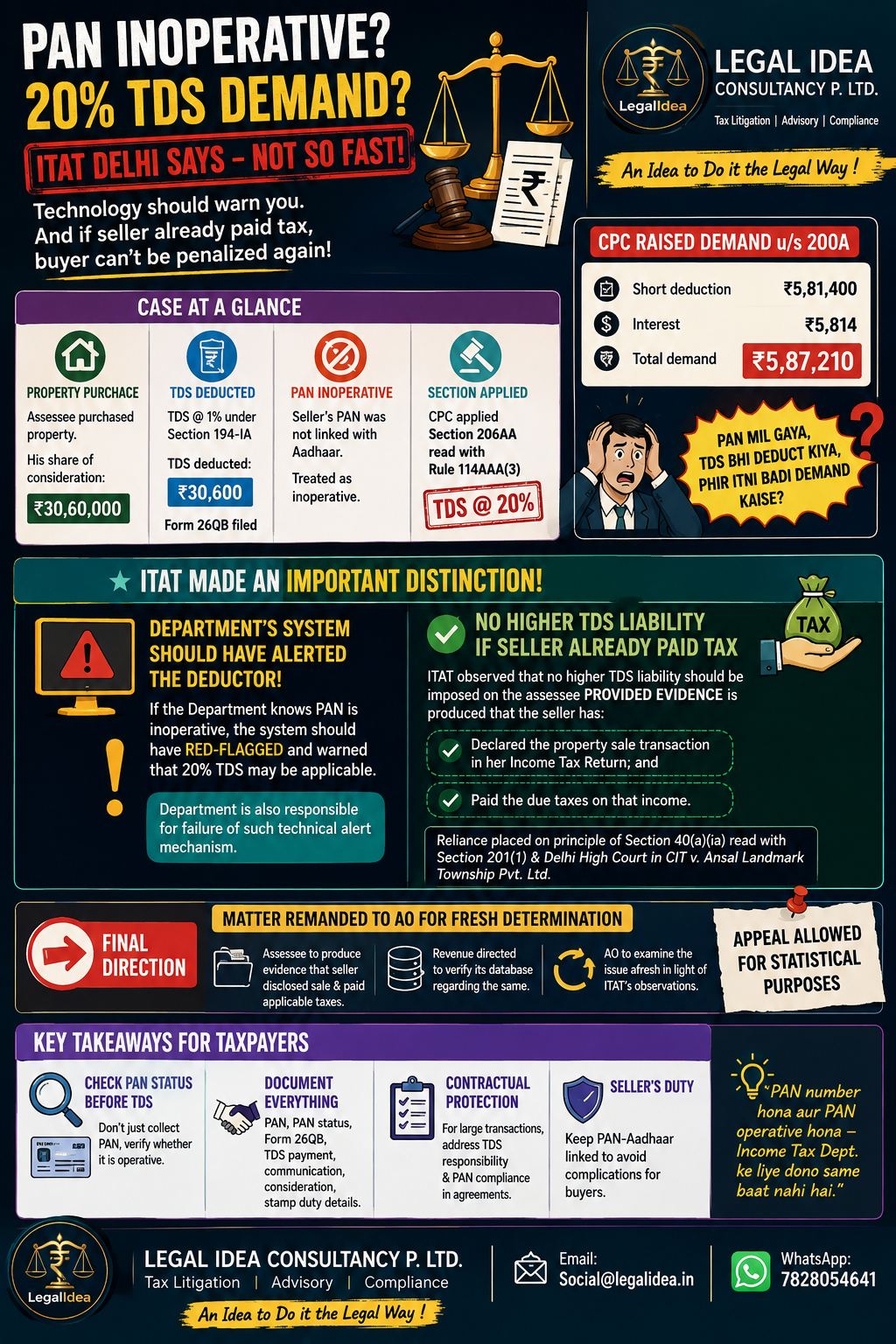
Sanchit Gupta v. DCIT, CPC, TDS
When the seller's PAN is inoperative due to Aadhaar non-linking, can a property buyer automatically face 20% TDS liability? Delhi ITAT gives an important, fact-specific answer.
1. Brief Summary of the Case
The assessee purchased an immovable property along with two co-owners. His share of the consideration was ₹30.60 lakh.
He deducted TDS at 1% under Section 194-IA, amounting to ₹30,600, and filed Form 26QB.
However, the seller's PAN was not linked with Aadhaar and was therefore treated as inoperative. CPC, TDS consequently applied Section 206AA read with Rule 114AAA(3) and treated the TDS as deductible at 20%.
The assessee challenged the demand before CIT(A), but the appeal was dismissed. The matter then reached the Delhi ITAT.
2. Court / Tribunal & Bench
Tribunal
Income Tax Appellate Tribunal, Delhi Bench “G”, New Delhi
Members
Shri Ramit Kochar
Accountant Member
Shri Yogesh Kumar U.S.
Judicial Member
Date of Pronouncement: 21 May 2026
3. Case Number & Parties
Case
ITA No. 8431/Del/2025
Assessment Year: 2024-25
Parties
Appellant:
Sanchit Gupta
Respondent:
DCIT, CPC, TDS
The appeal arose from the CIT(A)'s order dated 09.10.2025, confirming the CPC-TDS demand arising from processing of Form 26QB under Section 200A.
4. Facts & Core Issue
The assessee purchased the property in August 2023 and his share of consideration was ₹30.60 lakh.
Under Section 194-IA, he deducted TDS at 1% amounting to ₹30,600.
However, because the seller's PAN was not linked with Aadhaar, the PAN was treated as inoperative and the higher TDS mechanism under Section 206AA read with Rule 114AAA(3) became relevant.
CPC-TDS treated the applicable rate as 20% because the seller's PAN was inoperative.
5. What Was the Assessee's Defence?
The assessee essentially argued:
The assessee also pointed out that:
- The PAN was subsequently linked with Aadhaar.
- The seller completed Aadhaar-PAN linking in August 2024.
- The seller paid the applicable late fee.
- The assessee approached the seller after becoming aware of the demand.
- The transaction was bona fide and there was no deliberate attempt to avoid TDS.
6. What Did CIT(A) Say?
CIT(A) adopted a strict statutory approach.
↓
Deemed non-furnishing of PAN
↓
Section 206AA applies
↓
TDS at 20%
CIT(A) also held that the responsibility for complying with Section 206AA rested upon the deductor.
It further observed that subsequent Aadhaar linking would not retrospectively validate the transaction or reduce the liability already determined under Section 200A.
7. What Did ITAT Say?
The ITAT did not completely accept the assessee's argument that subsequent PAN-Aadhaar linking automatically removed the TDS liability.
The Tribunal noted:
- The property was purchased in August 2023.
- At that time, the seller's PAN was inoperative.
- The relevant extended Aadhaar-linking date was 31 May 2024.
- The seller claimed to have linked PAN with Aadhaar only in August 2024.
8. The Important Distinction Made by ITAT
The Tribunal observed that where the Department itself knew that a PAN was inoperative, the system should ideally have red-flagged the PAN and alerted the deductor about the possible 20% TDS consequence.
The Tribunal noted the continuous technological development of the Income Tax Department's systems and considered the absence of such a technical alert mechanism as an important factor in the circumstances of this case.
9. Another Major Finding — Did the Seller Pay Tax?
The Tribunal then adopted a taxpayer-protective approach.
On the facts and circumstances, no higher TDS liability should be imposed on the assessee provided evidence is produced that the seller had:
2. Paid the due taxes on that income.
The Tribunal compared the situation with the principle under Section 40(a)(ia) read with Section 201(1), where consequences can be avoided in appropriate circumstances when the recipient has disclosed the income and paid tax.
The Tribunal also referred to the Delhi High Court decision in CIT v. Ansal Landmark Township Pvt. Ltd.
10. ITAT Did NOT Give a Blanket Waiver
❌ Wrong Reading
“PAN not linked with Aadhaar? Don't worry, no 20% TDS.”
✅ Correct Reading
The assessee must establish that the seller disclosed the property sale and paid the applicable taxes.
The Revenue was simultaneously directed to verify its database to determine whether the seller had actually disclosed the income and paid the taxes.
11. CBDT Circulars Considered
Consequences relating to inoperative PAN under Rule 114AAA(3) were stated to take effect from 01.07.2023.
The deadline for PAN-Aadhaar linking was extended for transactions entered into up to 31.03.2024 to 31.05.2024.
The Tribunal also referred to a later relaxation for specified transactions where PAN was subsequently made operative within the prescribed period.
12. Final Direction
The matter was sent back to the AO for de novo determination.
The AO has to examine the issue afresh in light of the Tribunal's observations.
- The assessee has to produce evidence regarding the seller's disclosure of the property sale.
- The assessee has to produce evidence regarding payment of tax by the seller.
- The Revenue has been directed to verify its own database.
13. Final Outcome
The demand was not finally deleted by the ITAT. The issue was remanded for fresh verification.
Seller's tax disclosure → To be verified
Seller's tax payment → To be verified
Final TDS liability → Fresh determination by AO
14. The Real Takeaway for Property Buyers
Before paying for property, don't just ask:
Also check:
For a property transaction requiring TDS under Section 194-IA, the buyer should maintain evidence of:
- Seller's PAN
- PAN status
- Aadhaar linkage status, where relevant
- Form 26QB
- TDS payment challan
- Property consideration
- Stamp duty value
- TDS calculation
- Seller's details
- Communication regarding PAN/Aadhaar status
15. Protect Yourself Contractually
For large property transactions, the agreement and payment documentation should ideally clearly deal with:
Buyer Protection
- TDS responsibility
- Seller PAN details
- Tax compliance
- Seller cooperation
Before Payment
- Verify PAN status
- Resolve PAN issue
- Document communication
- Calculate TDS correctly
If the seller's PAN has an issue, resolve it before the payment or TDS event wherever possible.
16. Funny but Useful Client Takeaway 😄
Tax Consultant: “PAN mil gaya… ab check karo PAN chal bhi raha hai ya nahi.”
17. One-Line Professional Lesson
VERIFY PAN STATUS.
Where the Department's own system fails to alert the deductor, the system failure can become an important factor in the taxpayer's defence — particularly where the underlying tax has been disclosed and paid by the recipient.
The order ultimately reinforces a practical compliance lesson: property buyers deducting TDS should verify the seller's PAN status before completing the transaction and preserve evidence supporting the TDS calculation.
Property TDS — Quick Buyer Checklist
- Collect the seller's PAN.
- Verify whether the PAN is operative.
- Check Aadhaar-PAN linkage status where relevant.
- Calculate TDS under Section 194-IA.
- File Form 26QB correctly.
- Pay TDS within the prescribed time.
- Preserve challan and Form 26QB records.
- Keep written communication with the seller regarding PAN status.
- For high-value transactions, consider appropriate contractual protection.
- Maintain the complete property transaction file.
LEGAL IDEA CONSULTANCY P. LTD.
Tax Advisory • Income Tax • GST • Litigation • Compliance
An Idea to Do in Legal Way
Case: Sanchit Gupta v. DCIT, CPC, TDS | ITA No. 8431/Del/2025 | ITAT Delhi | Pronounced: 21 May 2026

Comments
2