
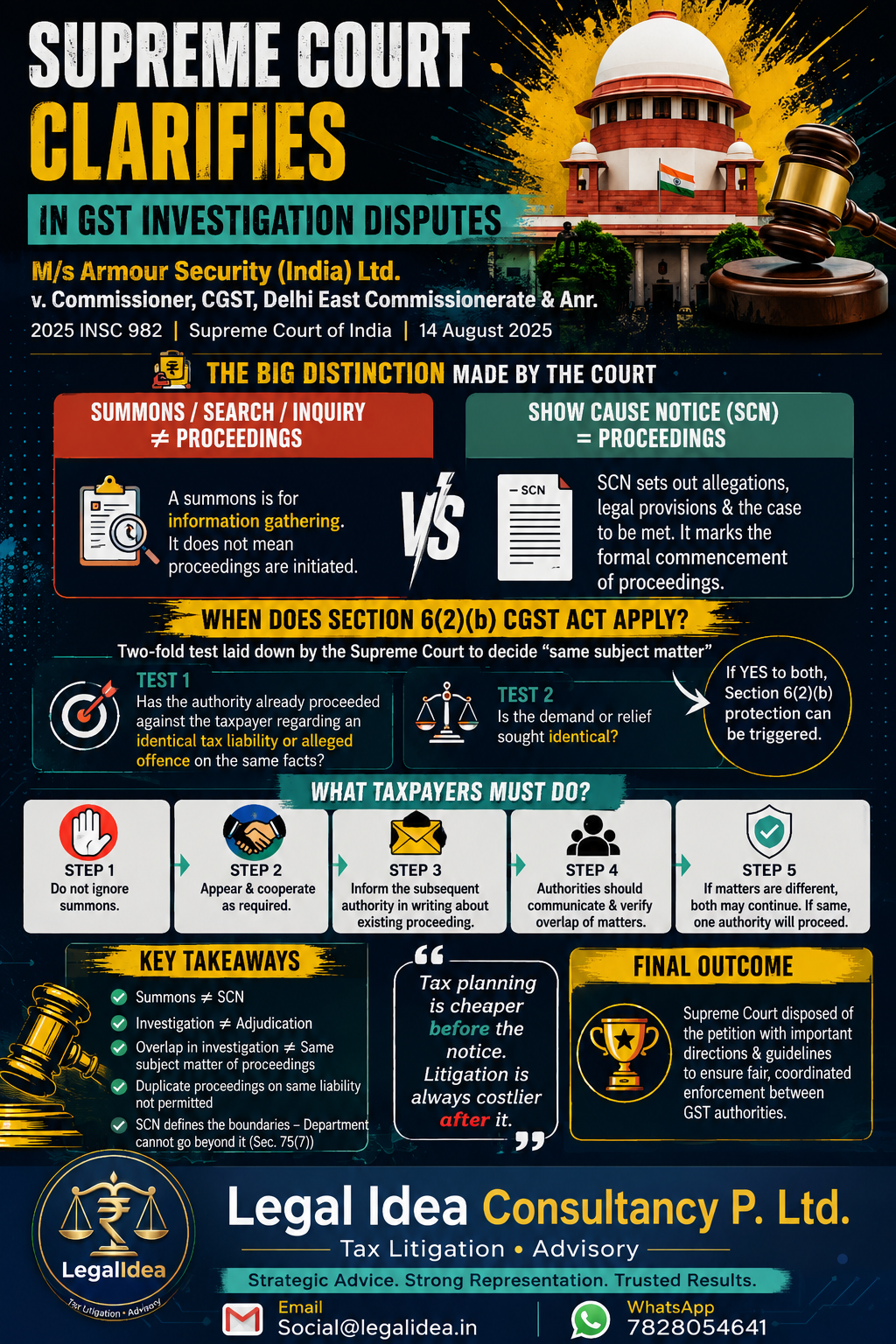
M/s Armour Security (India) Ltd. v. Commissioner, CGST, Delhi East & Anr.
Investigation can overlap. Adjudicatory proceedings cannot. The Supreme Court draws the line between summons, investigation and formal GST proceedings.
1. Brief Summary of the Case
This judgment is fundamentally about parallel GST investigations by Central and State authorities and the interpretation of Section 6(2)(b) of the CGST Act.
The taxpayer argued that the State authority had already issued a Show Cause Notice on the issue and therefore the Central authority could not subsequently summon or investigate the taxpayer on the same subject matter.
The Supreme Court drew an important distinction:
Investigation / Inquiry
Summons, search and information gathering are part of the investigative process.
Formal Proceedings
Proceedings under Section 6(2)(b) formally commence with issuance of a Show Cause Notice.
Therefore, a summons, search or seizure by itself does not amount to initiation of formal proceedings under Section 6(2)(b).
However, once the subject matter crystallises through an SCN, another GST authority cannot initiate proceedings concerning the same or overlapping tax liability or contravention.
2. Court & Bench
Court: Supreme Court of India
Jurisdiction: Civil Appellate Jurisdiction
Bench:
- Hon’ble Justice J.B. Pardiwala
- Hon’ble Justice R. Mahadevan
Judgment: 14 August 2025
3. Case Number & Citation
Special Leave Petition (Civil) No. 6092 of 2025
Citation: 2025 INSC 982
The Supreme Court ultimately disposed of the petition after deciding the important legal questions involved.
4. Petitioner / Respondents
Petitioner: M/s Armour Security (India) Ltd.
The company was engaged, among other activities, in providing security services and was registered under GST in Delhi.
Respondents: Commissioner, CGST, Delhi East Commissionerate & Anr.
5. Facts of the Case
The taxpayer had already received a Show Cause Notice dated 18 November 2024 under Section 73 for FY 2020-21.
The demand comprised CGST, SGST and IGST along with applicable interest and penalty.
The allegations included:
- Mismatch / non-reconciliation of turnover with other returns and e-way bill information.
- Excess availment of Input Tax Credit.
Subsequently, on 16 January 2025, officers conducted a search under Section 67(2), seized electronic devices/documents and issued summons under Section 70 to directors of the company.
Another summons followed on 23 January 2025.
The taxpayer argued that another GST authority was already examining the same issue and therefore Section 6(2)(b) should prevent the second authority from proceeding.
6. Core Legal Issue
The Supreme Court essentially examined three connected questions:
Issue 1
Does issuance of a summons under Section 70 amount to initiation of proceedings under Section 6(2)(b)?
Issue 2
What exactly is the “same subject matter” under Section 6(2)(b)?
Issue 3
What does an “order” under Section 6(2)(a) mean in the GST framework?
7. Court's Finding No. 1 — Summons ≠ Proceedings
A summons is essentially part of information gathering and inquiry.
At the summons stage, the Department may still be determining whether proceedings should be initiated at all.
The Supreme Court held that merely issuing a summons does not mean that proceedings under Section 6(2)(b) have been initiated.
Summons
“Give us information.”
SCN
“Here is the allegation. Explain why action should not be taken.”
This distinction is central to the judgment.
8. But the Court Also Warned GST Officers
The Supreme Court did not give the Department an unrestricted licence to issue endless summons.
- Summons should not be issued routinely.
- Summons should not be issued for documents already readily available on the GST portal.
- Repeated or cyclostyled summons may indicate a roving inquiry.
9. Court's Finding No. 2 — When Does GST Proceedings Actually Begin?
The Court connected Section 6(2)(b) with the Show Cause Notice.
A SCN:
- Sets out the allegations.
- Identifies the relevant legal provisions.
- Tells the taxpayer the case they have to meet.
- Provides an opportunity to respond.
- Forms the foundation for adjudication.
The statutory framework therefore ties initiation of proceedings to the SCN.
A summons does not necessarily provide that certainty. An SCN does.
10. The Most Important Part — What is “Same Subject Matter”?
Section 6(2)(b) does not automatically apply merely because two authorities are looking at the same taxpayer.
The focus is on the tax liability, deficiency, obligation or contravention actually being pursued.
The subject matter is essentially connected with the determination of tax liability or the dispute which the Department seeks to adjudicate.
The SCN is crucial because it identifies what the Department is actually alleging.
11. Supreme Court's Two-Fold Test
Has the authority already proceeded against the taxpayer regarding an identical tax liability or alleged offence on the same facts?
Is the demand or relief sought identical?
If both point towards the same liability or contravention, Section 6(2)(b) can be attracted.
This is much more useful than simply comparing words appearing in two summons.
12. Important Distinction Made by the Court
≠
SAME SUBJECT MATTER OF PROCEEDINGS
A summons may investigate something which appears to overlap with an existing SCN. That alone does not make the two matters identical.
The subject matter has to be determined from the actual proceedings and SCN, not merely from what a summons happens to ask for.
The Court specifically rejected the taxpayer's argument that because the summons touched upon ITC from cancelled dealers, it automatically became the same subject matter as the earlier SCN.
13. Another Powerful Finding — SCN Sets the Boundary
The SCN should establish the foundation of the Revenue's case.
A later order cannot travel beyond the grounds specified in the notice.
Section 75(7) provides that the demand cannot exceed the amount specified in the notice and no demand can be confirmed on grounds other than those specified in the notice.
14. What Happens When Two Proceedings Actually Overlap?
The Supreme Court was clear.
If two proceedings seek to assess or recover an identical or partially overlapping tax liability, deficiency or obligation arising from the same contravention, the Section 6(2)(b) bar is attracted.
But if the proceedings relate to distinct infractions, Section 6(2)(b) is not attracted merely because the tax amount or broad issue looks similar.
15. What About Central vs State GST Authority?
The Court explained that GST operates through both a single interface and cross-empowerment.
Both Central and State authorities can have enforcement powers in appropriate situations.
Therefore, simply saying:
is not enough to stop Central enforcement action.
Similarly, administrative assignment to the Centre does not automatically prevent State enforcement action.
Intelligence-based enforcement can be initiated by either administration.
16. But Once One Authority Starts Intelligence-Based Enforcement...
But duplication of adjudicatory proceedings is not.
The Department cannot simply create a parallel adjudicatory proceeding on the same subject matter.
The Supreme Court's conclusion makes it clear that parallel proceedings should not be initiated by the other tax administration when one administration has already initiated intelligence-based enforcement action.
17. The Court's Guidelines — Very Important for Taxpayers
-
Do not simply ignore a summons.
The taxpayer is initially required to appear and furnish the required response. -
Inform the subsequent authority in writing.
If another authority is already examining the same matter, place that fact formally on record. -
Authorities should communicate with each other.
They should verify whether the alleged overlap is genuine. -
If matters are different, reasons should be given.
The taxpayer should be informed in writing about the distinct subject matters. -
If matters are the same, authorities should decide who continues.
The taxpayer cannot insist on choosing which authority should conduct the investigation.
18. What if Authorities Cannot Agree?
If the authorities cannot decide which one should continue, the authority that first initiated the inquiry/investigation gets to carry it to its logical conclusion.
The Court can also pass an appropriate order for transfer of the inquiry/investigation.
If the authorities do not follow these guidelines, the taxpayer can approach the concerned High Court under Article 226.
19. Final Outcome
The Supreme Court essentially upheld the Delhi High Court's approach that summons issued during inquiry/search could not, merely by themselves, be treated as initiation of proceedings under Section 6(2)(b).
However, the larger legal principles laid down by the Supreme Court are much more significant than the individual summons dispute.
🔥 The Real GST Takeaway
Summons is investigation.
SCN is initiation of formal proceedings.
Investigation may overlap.
But duplicate adjudicatory proceedings on the same subject matter cannot continue.
For taxpayers facing Central and State GST action, don't simply argue that “another officer is already investigating.”
Compare the actual SCNs, tax periods, allegations, tax liability, contravention and relief sought.
The question is not merely “Who is investigating?” The real question is “What exactly is being adjudicated?”
LEGAL IDEA CONSULTANCY P. LTD.
Tax Litigation • GST Advisory • Income Tax • Regulatory Compliance
An Idea to Do in Legal Way

Comments
2