
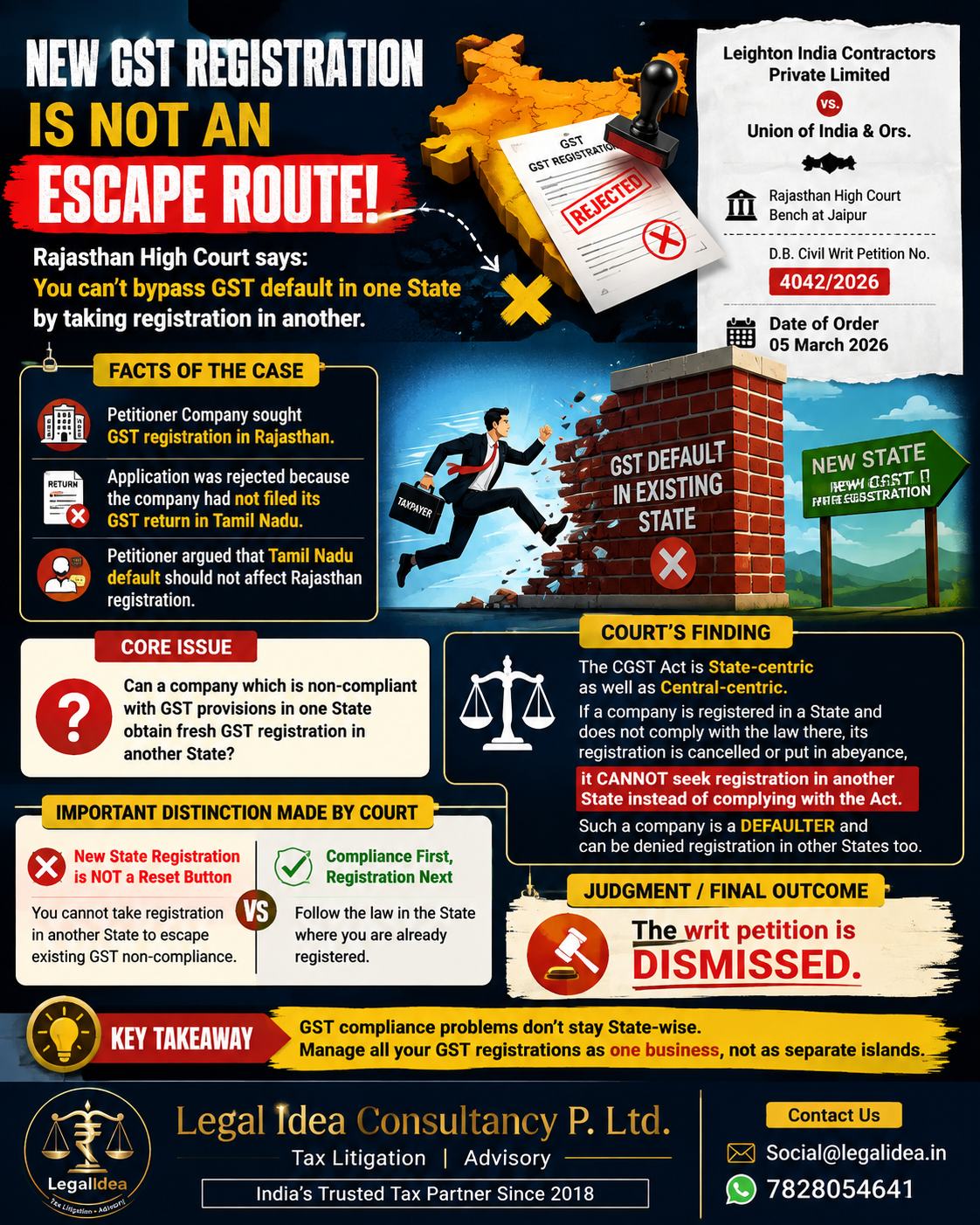
Leighton India Contractors Private Limited v. Union of India & Ors.
GST registration in another State is not a reset button for existing GST non-compliance.
1. Brief Summary of the Case
The Rajasthan High Court considered whether a company could obtain GST registration in Rajasthan when its GST compliance in another State — Tamil Nadu — was already in default.
The company argued that because its return had not been filed in Tamil Nadu, that should not become a ground to deny its GST registration in Rajasthan.
The High Court disagreed.
The Court held that where a company is already registered in one State and fails to comply with GST requirements there, it cannot simply move to another State and seek fresh registration without first complying with the applicable provisions.
The writ petition was therefore dismissed.
2. Court & Bench
High Court of Judicature for Rajasthan, Bench at Jaipur
5 March 2026
Hon’ble Acting Chief Justice Mr. Sanjeev Prakash Sharma
Hon’ble Mrs. Justice Shubha Mehta
3. Case Number
D.B. Civil Writ Petition No. 4042/2026
Petitioner:
Leighton India Contractors Private Limited
Respondents:
- Union of India
- State of Rajasthan
- Superintendent, Central Processing Cell CGST, Jaipur
- Chief Commissioner, Central Processing Cell CGST, Jaipur
- Chief Commissioner, CGST, Jaipur
4. Facts of the Case
The petitioner company approached the Rajasthan High Court seeking GST registration in Rajasthan under the CGST Act, 2017.
According to the petitioner, its Rajasthan registration was not being granted because it had not filed its return in Tamil Nadu.
The company's argument was essentially:
That sounds reasonable at first glance.
But the Court looked at the GST framework differently.
5. Core Issue
The key question was:
The Court treated GST compliance as interconnected rather than allowing the taxpayer to treat each State registration as an entirely independent escape route.
6. Court's Findings
The Court made an important observation about the GST structure.
It noted that the Central GST Act operates in parallel with the State GST legislation and that the provisions are:
The Court then reasoned that if a company:
- is registered in a particular State;
- does not comply with the law there; and
- its registration is cancelled or placed in abeyance,
it cannot simply seek registration in another State instead of complying with the existing provisions.
The Court went further and observed that such a company would be treated as a defaulter, and therefore could be denied registration in another State as well.
7. Important Distinction Made by the Court
The practical distinction is:
The Court essentially said:
- First comply with the existing GST obligations.
- Don't use a new registration application to bypass them.
8. Judgment / Directions
The Court did not accept the petitioner's contention.
It held that there was no reason to accept the arguments advanced on behalf of the petitioner.
Final Direction
The petitioner's request for Rajasthan GST registration was not accepted.
9. Final Outcome
The Court's message was clear:
10. Funny but Useful Client Takeaway
You can't leave the GST problem in Tamil Nadu and start a fresh GST life in Rajasthan.
11. What Should Businesses Do Differently Tomorrow?
For businesses having registrations in multiple States, this judgment is a good reminder to maintain a State-wise GST compliance tracker.
Don't just track:
Also track:
A new GSTIN should be a business requirement — not a compliance escape route.
12. The Strongest Business Lesson
For a multi-State business, GST compliance should not be managed like:
That GSTIN belongs to Tamil Nadu.”
It should be managed like:
That's the compliance mindset this judgment should trigger.
An Idea to Do in Legal Way
Tax Litigation • GST Advisory • Compliance • Appeals
Email: Social@legalidea.in | WhatsApp: 7828054641

Comments
2