
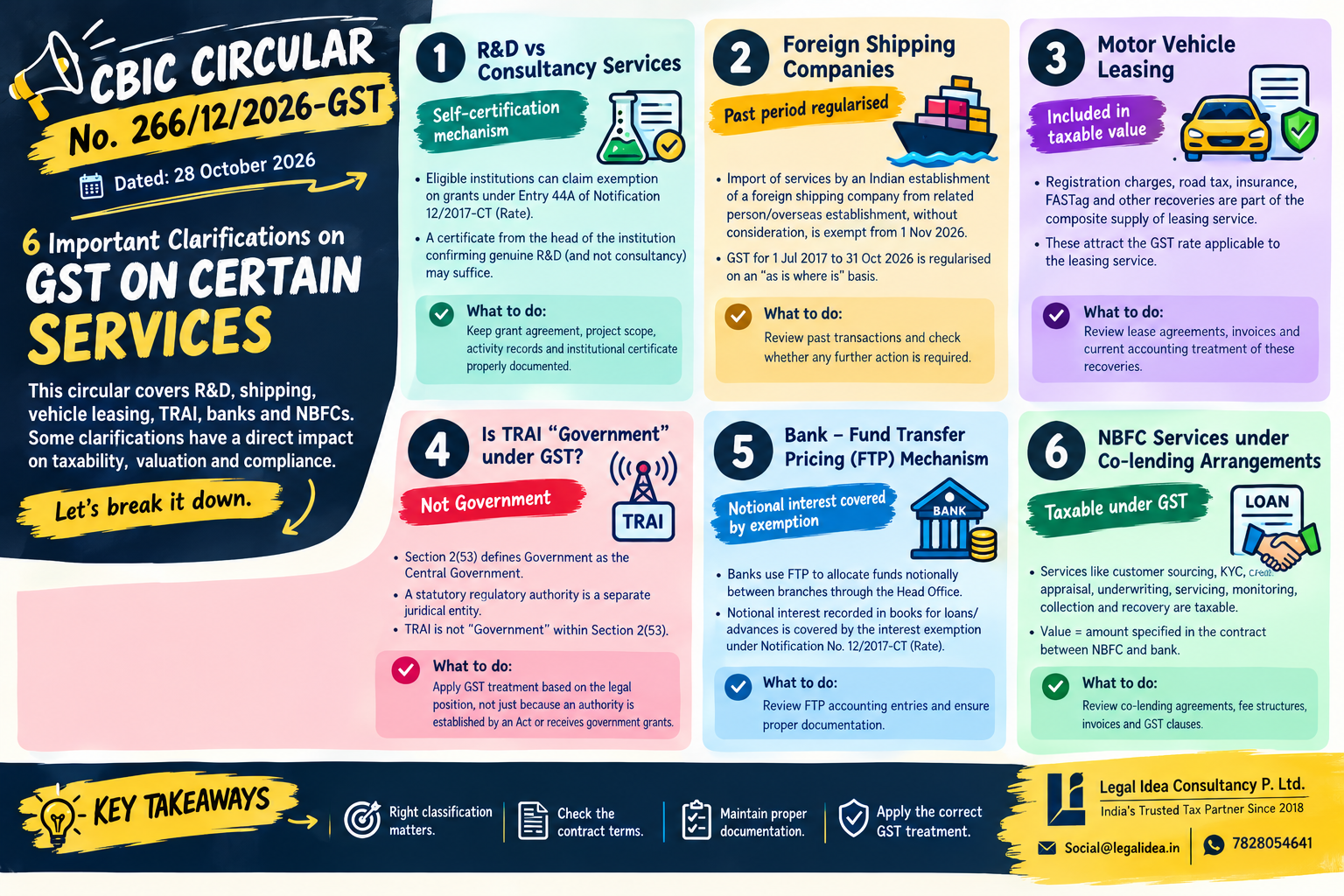
Six important GST clarifications from CBIC
Circular No. 266/12/2026-GST explains the GST treatment of selected services involving research institutions, shipping companies, vehicle leasing, TRAI, banks and NBFCs.
These are not merely procedural clarifications. Some directly affect the taxability and valuation of transactions. The circular follows recommendations of the 57th GST Council meeting held on 8 October 2026 and addresses six distinct areas.
1. Key clarifications explained
R&D services vs consultancy services
Exemption under Entry 44A of Notification No. 12/2017-CT (Rate) applies to eligible R&D services provided by specified government entities, research associations, universities, colleges and other notified institutions, where consideration is received as grants.
- The head of the concerned institution may issue a certificate confirming that the activity is genuinely R&D and not consultancy.
- Such a certificate may suffice for claiming the exemption.
Import of services by Indian establishments of foreign shipping companies
Import of services by an Indian establishment of a foreign shipping company from its related person or another establishment outside India, without consideration, is exempt with effect from 1 November 2026.
- GST payment for the period 1 July 2017 to 31 October 2026 is regularised on an “as is where is” basis.
Statutory and ancillary recoveries in motor vehicle leasing
Registration charges, road tax, insurance premium, FASTag charges and other incidental expenses recovered by the lessor from the lessee are connected with the leasing service.
- These expenses form part of the value of the composite supply of leasing service.
- They attract the GST rate applicable to the motor vehicle leasing service.
Is TRAI “Government” under GST?
Section 2(53) of the CGST Act defines Government as the Central Government. A statutory regulatory authority is a separate juridical entity.
- CBIC clarifies that TRAI is not “Government” within the meaning of Section 2(53).
Fund Transfer Pricing (FTP) mechanism in banks
Banks use FTP to notionally allocate funds between branches through the Head Office. The notional amount recorded as interest or cost of funds in connection with loans or advances is treated as “interest”.
- CBIC clarifies that it is covered by the interest exemption under Notification No. 12/2017-CT (Rate).
- It is not treated as a taxable financial service merely because the Head Office and branches are distinct persons under Section 25(4).
Services provided by NBFCs to banks under co-lending arrangements
NBFCs may provide customer sourcing, KYC, credit appraisal, underwriting, servicing, monitoring, collection and recovery services to banks under co-lending arrangements.
- These lending-related services are taxable under GST.
- The taxable value is the amount specified in the contractual agreement between the NBFC and the bank.
2. At a glance – GST impact
| Issue | CBIC clarification |
|---|---|
| Eligible R&D grants | Exemption supported by institutional certificate. |
| Foreign shipping company imports | Exempt from 1 November 2026; past period regularised on an “as is where is” basis. |
| Motor vehicle lease recoveries | Included in the composite supply value and taxed at the rate applicable to the leasing service. |
| TRAI | Not “Government” under Section 2(53) of the CGST Act. |
| Bank FTP notional interest | Covered by the interest exemption under Notification No. 12/2017-CT (Rate). |
| NBFC co-lending services | Taxable; value determined as per the contract between the NBFC and bank. |
3. What businesses should do now
Review grant agreements, activity descriptions and R&D self-certification.
Reconcile historical import-of-service transactions and review the “as is where is” regularisation.
Revisit GST valuation and invoicing of statutory recoveries.
Review FTP accounting entries and supporting documentation.
Check co-lending contracts and service-fee arrangements.
Review the applicable GST treatment independently; do not presume a government-service exemption.
Source basis: Summary of CBIC Circular No. 266/12/2026-GST dated 28 October 2026, as provided. This page is an informational summary and should be read with the circular and applicable statutory provisions before taking a tax position.

Comments
2