
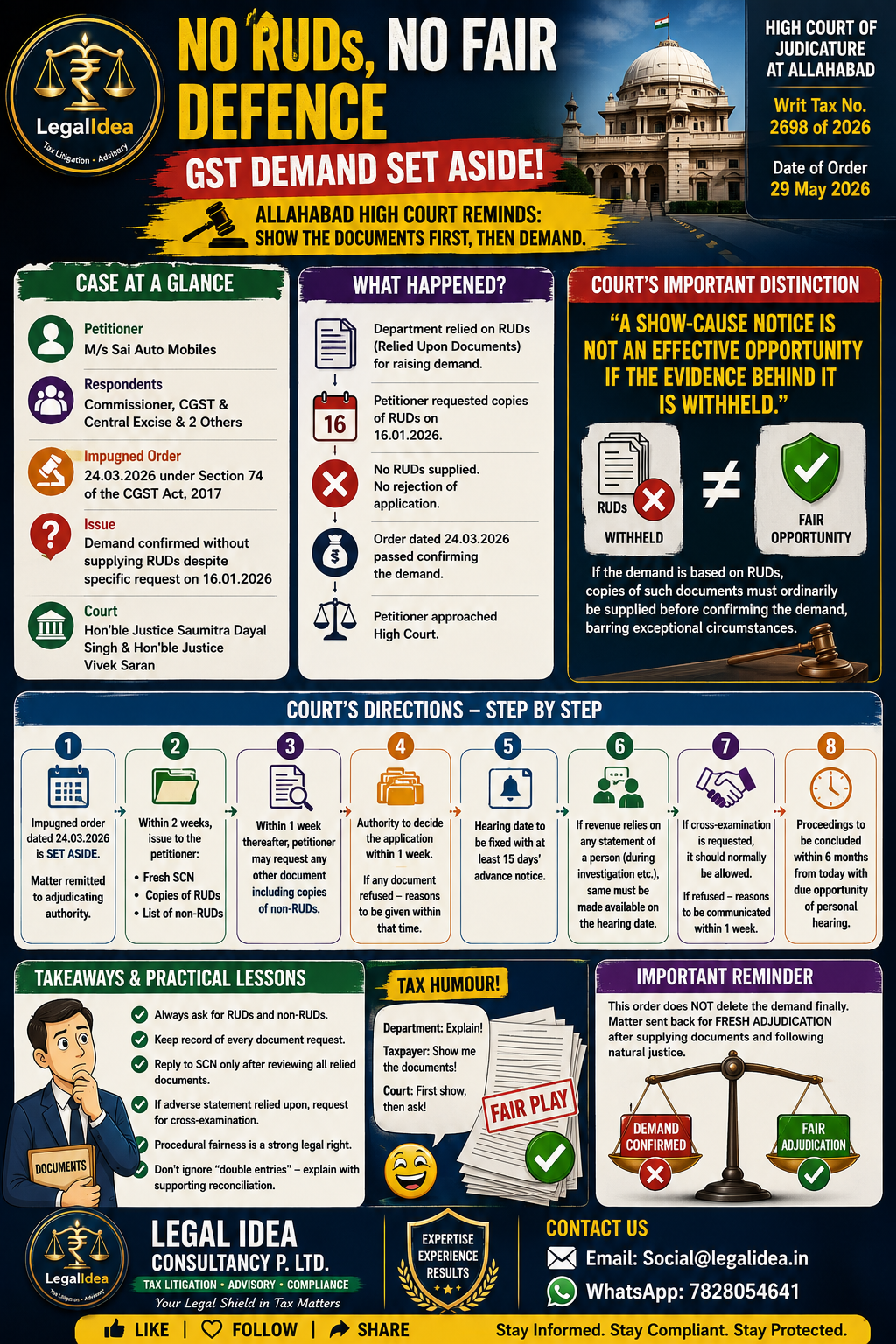
M/s Sai Auto Mobiles v. Commissioner, CGST & Central Excise
A significant Allahabad High Court ruling on the taxpayer's right to receive Relied Upon Documents before a GST demand is confirmed.
Parties
Petitioner
M/s Sai Auto Mobiles
Respondents
Commissioner, Central Goods & Service Tax & Central Excise and 2 Others
Proceedings
Challenge to order dated 24 March 2026 passed under Section 74.
Facts & Core Issue
The petitioner challenged an order dated 24 March 2026, passed under Section 74 of the CGST Act, 2017.
The main grievance was straightforward: the Department relied upon RUDs — Relied Upon Documents — but did not provide copies of those documents to the taxpayer.
RUDs were relied upon — but the taxpayer said those documents were never supplied.
The petitioner had specifically applied for the RUDs on 16 January 2026.
Application Made
RUDs were specifically requested on 16 January 2026.
No Rejection
The request was not rejected.
Demand Confirmed
The demand was ultimately confirmed without satisfactory proof that the RUDs had been supplied.
Another Issue — Alleged Double Entries
The petitioner also claimed that certain double entries appeared in its accounts.
According to the petitioner, these entries had already been explained in its reply, but the explanation was not considered while passing the order.
Department's Objection
Alternative Statutory Remedy
The Revenue argued that the taxpayer had an alternative statutory remedy of appeal.
However, the High Court examined the nature of the grievance and called for instructions from the Revenue.
No satisfactory explanation was received establishing that the RUDs had actually been supplied before confirmation of the demand.
🧑⚖️ Court's Central Finding
If the proposed demand is based on RUDs, the taxpayer must ordinarily get copies of those documents before the demand is confirmed.
Without those documents, the taxpayer's reply may remain incomplete and the ability to effectively object to the proposed demand may be impaired.
🔥 The Important Distinction
“A SHOW-CAUSE NOTICE IS NOT AN EFFECTIVE OPPORTUNITY IF THE EVIDENCE BEHIND IT IS WITHHELD.”
The department cannot effectively say: “Here is the demand. Now defend yourself.” while withholding the documents on which that demand is based.
What Effective Adjudication Requires
📌 Cross-Examination — Another Important Safeguard
Statement Relied Upon
If the Revenue proposes to rely upon a person's statement against the taxpayer, the statement must be made available to the taxpayer.
Opportunity of Cross-Examination
Where an adverse statement is relied upon, normally an opportunity of cross-examination should be allowed if the taxpayer asks for it.
If Cross-Examination Is Refused
Adequate reasons must be communicated within one week of the application.
⚖️ Judgment / Directions
GST Demand Order — SET ASIDE
- The order dated 24 March 2026 was set aside.
- The matter was remitted back to the adjudicating authority for fresh adjudication.
- The taxpayer was to receive the relevant documents and procedural safeguards before fresh adjudication.
Documents to be Supplied
Fresh SCN
Fresh copy of the original Show Cause Notice.
RUDs
Copies of all Relied Upon Documents.
Non-RUDs
List of non-RUD documents, with access to other requested documents subject to the directions.
⏱️ Timelines Fixed by the Court
Weeks
Time to issue the fresh SCN, RUDs and list of non-RUDs.
Days
Advance notice before the hearing.
Months
Proceedings to be concluded after due opportunity of personal hearing.
🎯 Final Outcome
Demand Order Set Aside
The order dated 24 March 2026 was set aside.
Fresh Adjudication
The matter was sent back to the adjudicating authority.
Not Final Tax Victory
The underlying tax dispute was not finally decided in favour of the taxpayer.
This is not “Tax demand cancelled forever.”
It is: “Demand order set aside because the taxpayer was not given a proper opportunity to defend itself.”
Department: “Please explain the allegations.”
Taxpayer: “Sure. Please give me the documents.”
Department: “...”
High Court: “Exactly. Give him the documents first.”
The lesson is simple:
You cannot properly defend a GST demand against evidence you have never been allowed to see.
A procedural victory is not necessarily a final victory on the tax demand.
The High Court sent the matter back for fresh adjudication. The Department therefore gets another opportunity and the taxpayer still has to fight the merits.
📋 GST Litigation Document Checklist
🚨 Future Planning / Client Guidance
Identify Every RUD
Immediately identify every Relied Upon Document mentioned in the SCN.
Request Missing Documents in Writing
If a document is missing, formally request it.
List Exact Documents
Do not simply write “documents not received”. Identify the exact documents required.
Reconcile Double Entries
Where alleged duplicate entries exist, reconcile them transaction-wise.
Put Your Explanation on Record
Ensure every accounting explanation is clearly included in the written reply.
Obtain Statements
If the Department relies upon a statement against you, obtain a copy of that statement.
Request Cross-Examination
Where required, specifically request the opportunity for cross-examination.
Preserve Every Request
Keep emails, portal submissions, acknowledgements and every other proof of document requests.
Never assume that filing an appeal is the only answer.
Sometimes the real issue is whether the original adjudication itself respected natural justice.
Writ Tax No. 2698 of 2026 | High Court of Judicature at Allahabad | Order dated 29 May 2026
Prepared for tax and legal awareness purposes. The case-specific facts, findings and directions should be read with the complete judgment/order before relying upon them in litigation or advisory work.

Comments
2