
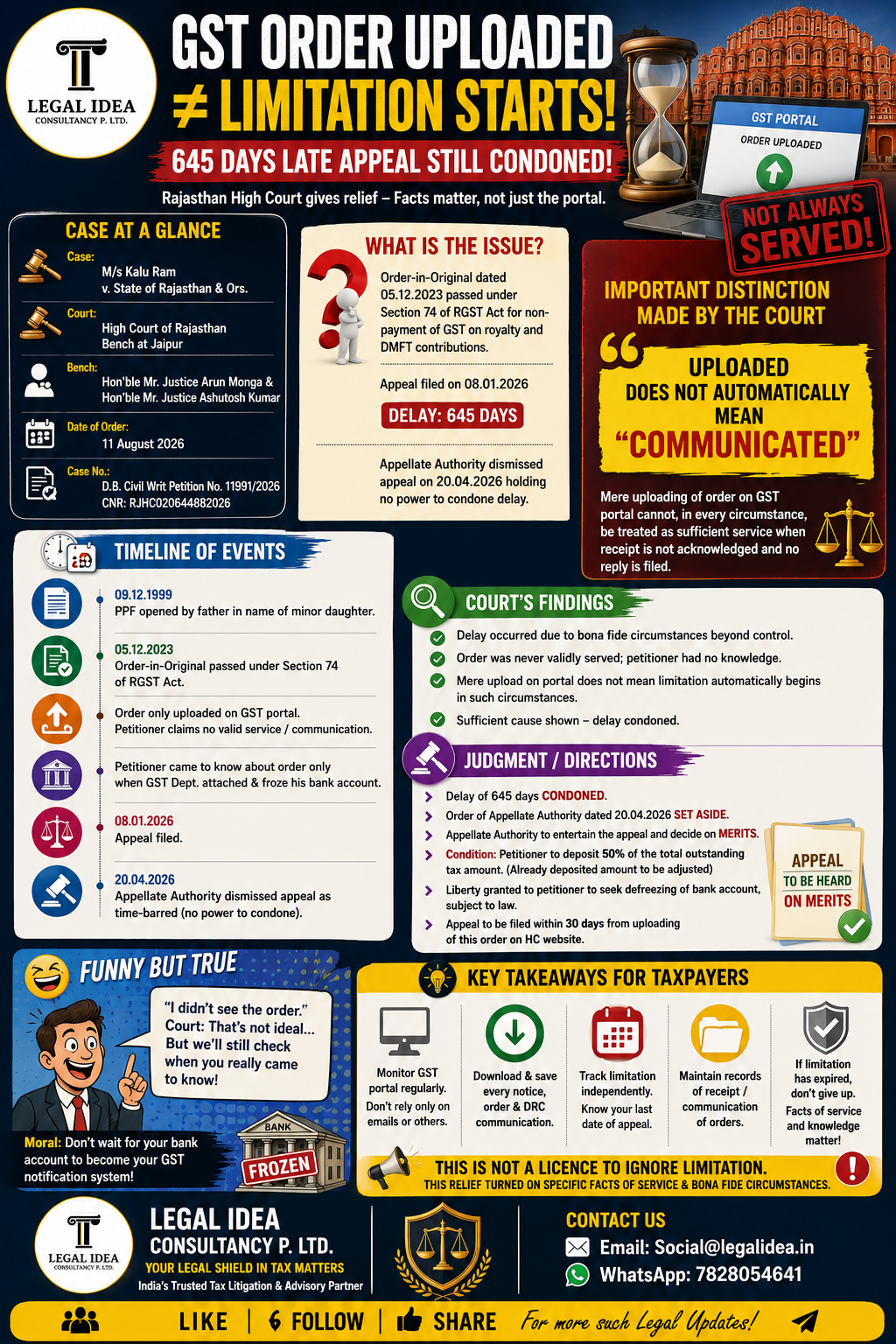
M/s Kalu Ram v. State of Rajasthan & Ors.
Rajasthan High Court examines whether mere uploading of a GST order on the portal is enough to trigger the limitation period for filing an appeal.
Parties
Petitioner
M/s Kalu Ram, through its proprietor Kalu Ram.
Respondents
State of Rajasthan, Assistant Commissioner, Appellate Authority and Union of India.
Core Dispute
Whether the GST appeal limitation had actually commenced when the order was merely uploaded on the GST portal.
Facts & Background
When does the GST appeal limitation period actually begin?
Does merely uploading an Order-in-Original on the GST portal automatically amount to valid communication to the taxpayer?
The Important Distinction
📤 Order Uploaded
Order is placed on the GST Common Portal.
📩 Order Communicated
The order is actually served or communicated to the taxpayer in the circumstances recognised by law.
“Uploaded” does not automatically mean “communicated”.
Court’s Important Findings
1. Service of the order matters
The Rajasthan High Court accepted the significance of the service issue and considered earlier decisions concerning communication of GST orders.
2. Mere portal uploading is not necessarily sufficient
The Court referred to earlier Rajasthan High Court decisions and also considered the Punjab & Haryana High Court decision in Luxmi Traders v. Union Territory of Chandigarh & Ors.
3. Limitation depends upon valid communication
The Court adopted the principle that where an Order-in-Original is served only by uploading it on the GST portal, the limitation period would not, in the circumstances discussed by the Court, be treated as having commenced without proper communication.
4. Knowledge of the order became a material issue
The petitioner claimed that he became aware of the demand only when the Department attached and froze the bank account. This factual circumstance was material to the Court’s consideration of limitation.
Judgment & Final Directions
645-Day Delay Condoned
The High Court condoned the delay in filing the appeal.
Appellate Order Set Aside
The Appellate Authority’s order dated 20 April 2026 was set aside.
Appeal to be Heard
The Appellate Authority was directed to entertain the appeal and decide it on merits.
50% Deposit Condition
The petitioner must deposit 50% of the total outstanding tax amount, after adjusting amounts already deposited.
Bank Account
The petitioner was permitted to approach the Appellate Authority for defreezing the bank account, subject to law.
30-Day Filing Window
The appeal must be filed within 30 days from uploading of the High Court order on its website.
Final Outcome
- 645-day delay — CONDONED.
- The earlier appellate dismissal was set aside.
- The appeal will now be considered on merits.
- The petitioner must comply with the condition of depositing 50% of the outstanding tax amount.
- The bank account may be considered for defreezing in accordance with law.
⚠️ Important: This is not a licence to ignore GST limitation
The decision turns heavily on the specific issue of service/communication of the order and the bona fide circumstances placed before the Court. It should not be treated as a general permission to file GST appeals years after the statutory limitation period.
GST Portal: “Order uploaded.”
Taxpayer: “I never received it.”
Bank Account: “Surprise!”
And that is exactly why GST portal monitoring cannot be treated as an optional exercise.
Future Planning / Client Guidance
“I didn't see the order” may become a legal argument. It should never become your compliance strategy.
Check the portal. Check notices. Check orders. Check DRC communications. And keep proper records of when every important GST communication was actually received.
D.B. Civil Writ Petition No. 11991/2026 | CNR: RJHC020644882026 | Order dated: 11 August 2026
Prepared for tax and legal awareness purposes. The case-specific facts, findings and directions should be read with the complete judgment/order before relying upon them in litigation.

Comments
2