
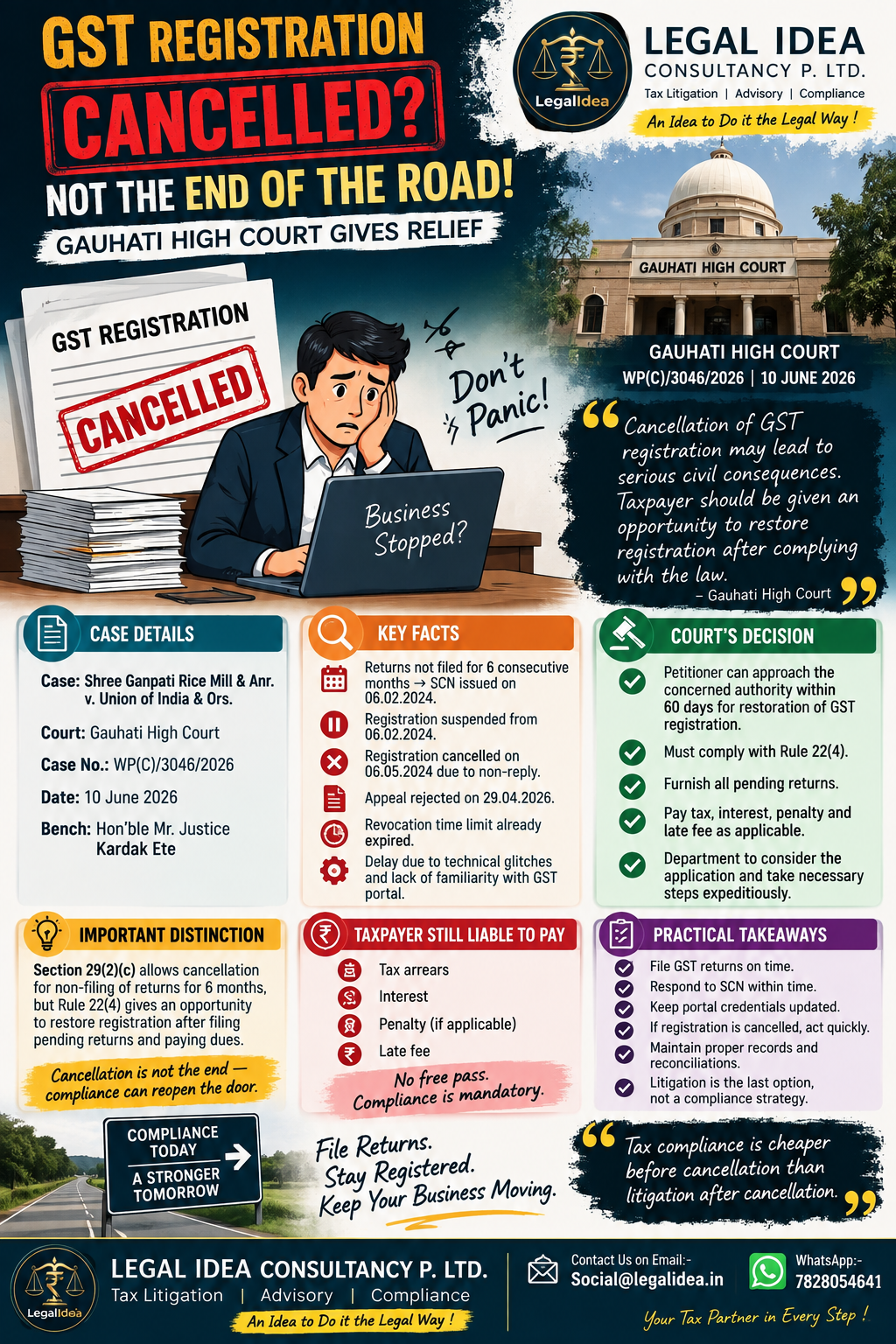
GST Registration Cancelled for Non-Filing? Restoration May Still Be Possible.
Gauhati High Court gives a taxpayer an opportunity to seek restoration of cancelled GST registration, subject to filing pending returns and payment of applicable dues.
1 Brief Summary of the Case
The taxpayer's GST registration was cancelled because GST returns had not been filed for a continuous period of six months.
A Show Cause Notice was issued, the registration was suspended and subsequently cancelled because the taxpayer did not submit a reply. The appeal against cancellation was also rejected and the normal period for filing a revocation application had expired.
The taxpayer was granted an opportunity to seek restoration of GST registration, subject to filing pending returns and paying the applicable tax, interest, penalty and late fee.
2 Court & Bench
3 Parties
Mrs. Bina Devi Agarwal
Principal Commissioner, GST Central Excise Service Tax
Additional Commissioner (Appeals)
Superintendent, Mangaldoi-I, Assam
4 Facts & Core Issue
The petitioner was a registered proprietorship firm under the CGST and Assam GST Acts.
The taxpayer submitted that the delay was connected with technical glitches and lack of familiarity with the GST portal and stated that returns had subsequently been updated up to March 2024.
5 Main Legal Question
Can cancelled GST registration be restored after the normal revocation period has expired?
The High Court answered this in favour of the taxpayer, subject to compliance with the conditions prescribed under Rule 22(4).
6 Court's Important Finding
The High Court relied upon its earlier Coordinate Bench decision in Dhirghat Hardware Stores & Anr. v. Union of India & 3 Ors.
The Court considered Section 29(2)(c) of the CGST Act and Rule 22 of the CGST Rules, 2017.
Where the taxpayer furnishes all pending returns and makes full payment of tax dues along with applicable interest and late fee, the proper officer can drop the cancellation proceedings and pass an order in FORM GST REG-20.
7 Important Distinction
Cancellation ≠ End of the Road
But restoration comes with compliance conditions.
The taxpayer remains liable for applicable:
Tax + Interest + Penalty + Late Fee
The judgment does not make GST non-compliance harmless. It provides an opportunity to cure the default and seek restoration in appropriate circumstances.
8 Why Did the High Court Intervene?
The Court noted that cancellation of GST registration results in serious civil consequences.
9 Final Directions
10 Arrears Still Have to Be Paid
The taxpayer must make payment of applicable:
Tax + Interest + Penalty + Late Fee
The relief is an opportunity to restore the registration after curing the underlying compliance default.
11 Section 73 Limitation — An Important Point
The Court also dealt with the period under Section 73(10) of the CGST/State GST Acts.
12 Final Outcome
The High Court granted the petitioner an opportunity to seek restoration of the cancelled GST registration.
- Approach concerned authority within 60 days
- Furnish pending GST returns
- Comply with Rule 22(4)
- Pay applicable tax
- Pay applicable interest
- Pay applicable penalty and late fee
13 Funny but Useful Client Takeaway 😄
Client:
“Sir, GST registration cancel ho gaya… ab business khatam?”
Tax Consultant:
The better professional takeaway: don't wait for cancellation.
14 What Should a Business Do Differently Tomorrow?
If Returns Are Pending
- Identify all pending GSTR-1 returns
- Identify all pending GSTR-3B returns
- Calculate tax liability
- Calculate applicable interest
- Check late fees
- Reconcile books with GST returns
- Verify ITC before filing
- File pending returns systematically
- Keep payment challans
- Keep filing acknowledgements
- Monitor GST portal notices
- Monitor GST orders
If Registration Is Already Cancelled
Don't simply assume that expiry of the normal revocation period means nothing can be done.
SCN → Cancellation Order → Appeal Order → Revocation Timeline → Pending Returns → Outstanding Tax / Interest / Late Fee → Available Legal Remedy
15 Strong Practical Lesson
There are actually three timelines every taxpayer should monitor.
Return Filing
Don't allow six consecutive months of non-filing.
SCN / Cancellation
If an SCN arrives, respond within the prescribed time and attend the hearing.
Revocation / Remedy
If registration is cancelled, don't casually ignore the statutory time limits.
Every missed deadline makes the next remedy harder.
Litigation should be the last resort — not the compliance strategy.
Tax Litigation • GST Advisory • Income Tax • Regulatory Compliance
Email: social@legalidea.in | WhatsApp: 7828054641

Comments
0