
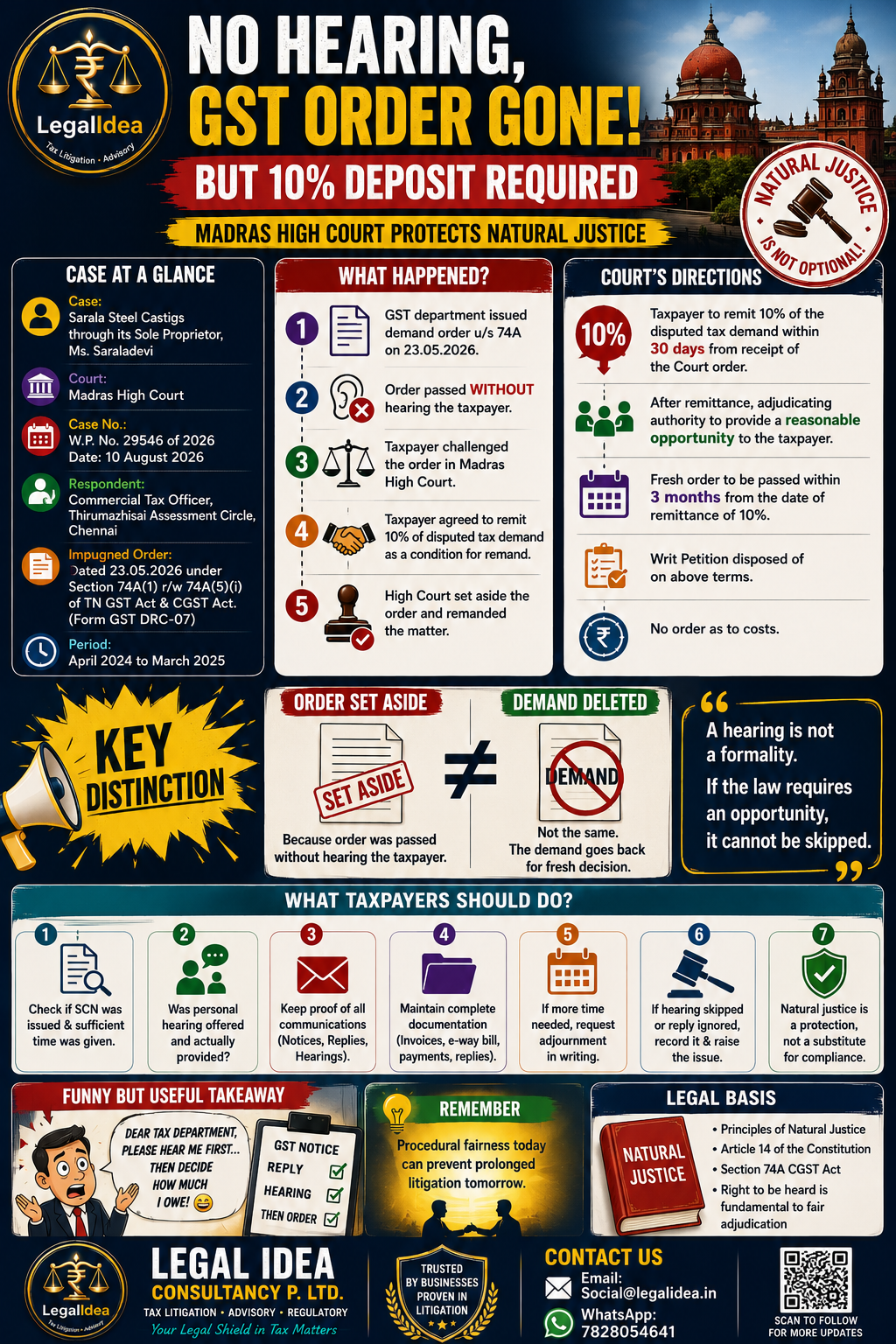
No Hearing? GST Order Set Aside.
Madras High Court sends the matter back for fresh adjudication — but the taxpayer must first deposit 10% of the disputed tax demand.
Parties
Petitioner
Sarala Steel Castigs, through its Sole Proprietor, Ms. Saraladevi.
Respondent
Commercial Tax Officer, Thirumazhisai Assessment Circle, Chennai.
Tax Period
April 2024 to March 2025
1. Facts & Core Issue
The GST order was passed without giving the taxpayer a hearing.
The taxpayer challenged the order dated 23 May 2026, passed under Section 74A(1) read with Section 74A(5)(i) of the TN GST Act and CGST Act.
The order was accompanied by Form GST DRC-07.
The challenge was straightforward:
NO HEARING = BREACH OF PRINCIPLES OF NATURAL JUSTICE
The High Court examined the impugned order and found that it had indeed been issued without hearing the petitioner.
2. 🧑⚖️ Court's Finding
The Court did not decide the underlying GST merits.
- The Court focused on the procedural defect.
- The absence of a hearing amounted to a breach of principles of natural justice.
- The matter was therefore sent back for reconsideration.
- The petitioner agreed to pay 10% of the disputed tax demand as a condition for remand.
3. 🔥 Important Distinction
ORDER SET ASIDE ≠ TAX DEMAND FINALLY DELETED
The High Court set aside the impugned order because the taxpayer had not been heard.
It did not decide that the underlying GST demand was incorrect.
❌ Wrong Interpretation
- “Madras HC cancelled the GST demand.”
- “The taxpayer has won the tax dispute.”
- “The liability has disappeared permanently.”
✅ Correct Interpretation
- The order was set aside for procedural violation.
- The matter was remanded for fresh adjudication.
- The taxpayer gets a reasonable opportunity to be heard.
Natural justice can reopen the adjudication. It does not automatically erase the tax liability.
The taxpayer still has to contest the underlying demand in the fresh proceedings.
4. ⚖️ Judgment / Directions
Impugned Order Set Aside
Order dated 23.05.2026 was set aside.
Matter Remanded
The matter was remanded to the assessing authority for reconsideration.
Deposit Required
The taxpayer must remit 10% of the disputed tax demand.
Payment Deadline
Payment to be made within 30 days from receipt of the Court order.
Fresh Opportunity
Fresh proceedings must be conducted after providing a reasonable opportunity to the taxpayer.
Fresh Order
Fresh order to be passed within 3 months from the date of remittance of the 10%.
The writ petition was disposed of and the connected miscellaneous petitions were closed.
No order as to costs.
5. 🎯 Final Outcome
GST ORDER SET ASIDE — BUT NOT A CLEAN TAX VICTORY.
- The taxpayer must pay 10% of the disputed tax demand.
- The taxpayer gets a fresh opportunity to contest the demand.
- The assessing authority must reconsider the matter.
- A fresh order must follow after due opportunity.
A hearing is not a formality.
📌 Future Planning / Compliance Guidance
Was an SCN issued?
Verify the existence and date of the show-cause notice.
Was sufficient time given to reply?
Preserve the notice and the permitted response period.
Was personal hearing offered?
Check the portal notices and hearing communications.
Did you actually receive the hearing opportunity?
Record the date, mode and communication of the hearing.
Was your reply considered?
Compare your reply with the reasoning in the final order.
Are procedural dates properly recorded?
Maintain a complete litigation timeline.
📂 Keep the Evidence
SCN
Show-cause notice and related communications.
GST Portal Notices
Download and preserve portal communications.
Reply Filed
Keep the complete reply and supporting documents.
ARN / Acknowledgement
Preserve proof of submission.
Hearing Notices
Maintain all hearing communications.
Adjournment Requests
Keep requests and acknowledgements.
Emails
Preserve relevant correspondence.
Personal Hearing Records
Document attendance and submissions.
Final Order
Keep the complete adjudication order.
Form GST DRC-07
Preserve the demand summary and related record.
“I never got a hearing” is an argument.
“Here is the portal record showing no hearing was granted” is evidence.
Don't wait for the writ petition stage.
If a hearing notice comes, attend it. If more time is required, request adjournment properly. If documents are missing, ask for them in writing.
Natural justice is a protection — not a substitute for responding to the GST notice.
Madras High Court | W.P. No. 29546 of 2026 | Order dated 10 August 2026
Prepared for tax and legal awareness purposes. The key issue highlighted is breach of natural justice arising from passing the GST order without hearing the taxpayer.

Comments
2