
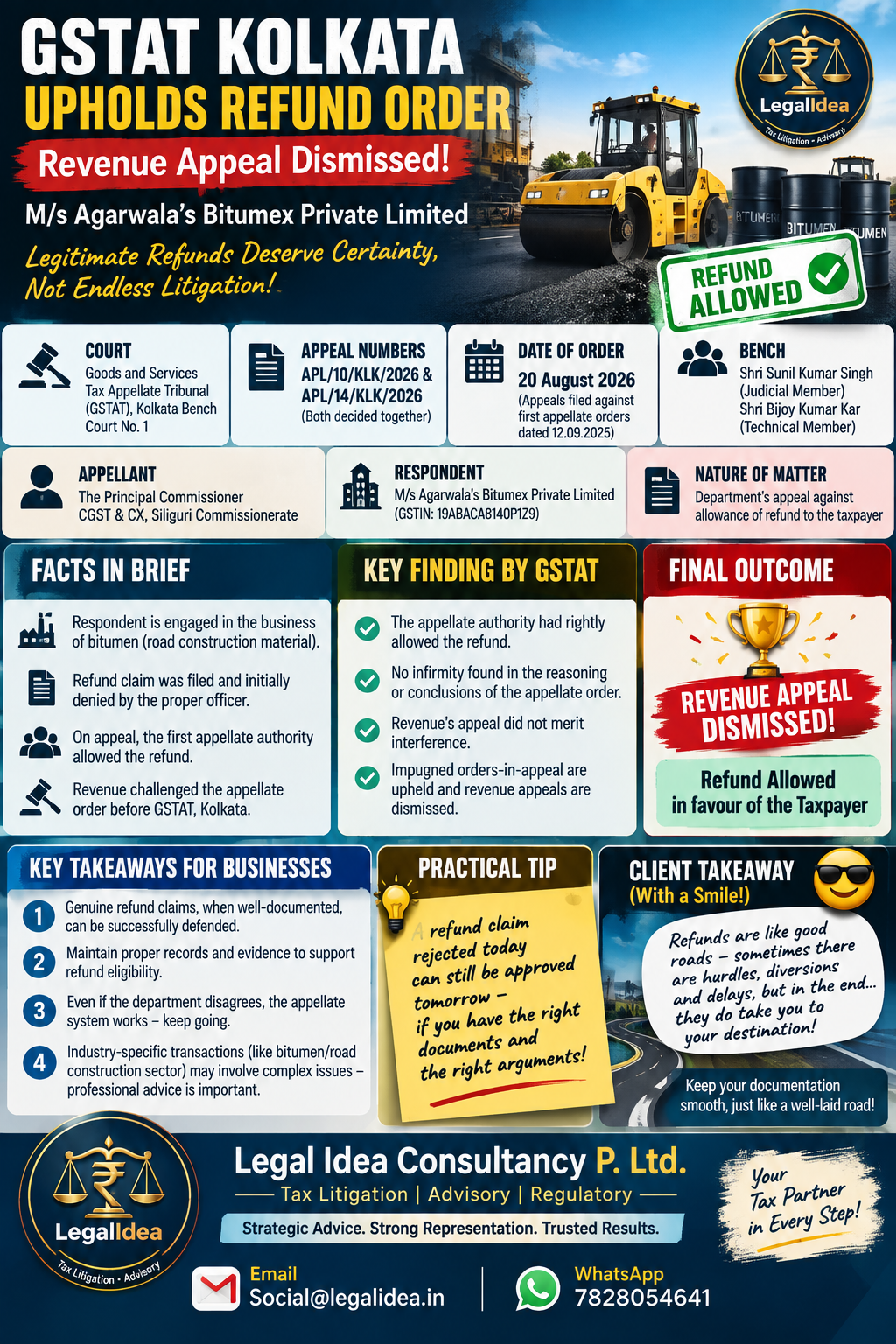
M/s Agarwala’s Bitumex Private Limited v. Principal Commissioner, CGST & CX
GSTAT Kolkata upholds refund of accumulated ITC and examines Bill-to-Ship-to transactions, toll-plaza evidence, second-line suppliers and new grounds raised at the appellate stage.
1. Brief Summary of the Case
The case concerns M/s Agarwala’s Bitumex Private Limited, an exporter of iron/non-alloy steel bars and bitumen.
The taxpayer claimed refund of accumulated ITC under Section 54 of the CGST Act for:
The original authority rejected both refund claims. The First Appellate Authority subsequently allowed the refunds. The Revenue challenged those decisions before GSTAT.
Final Result
GSTAT dismissed both Revenue appeals and upheld the orders allowing the taxpayer’s refund claims.
2. Court & Bench
3. Case Number & Parties
4. Facts & Core Issue
The taxpayer exported goods and claimed refund of accumulated ITC under Section 54 of the CGST Act.
Issue 1 — Toll-Plaza Movement
The Revenue argued that the vehicles did not show toll-plaza movement through West Bengal, even though the supplier was based in Kolkata.
According to the Revenue, vehicle movement was reflected through Bihar and Uttar Pradesh and therefore the Department questioned whether the goods had actually originated from the declared location.
Issue 2 — Second-Line Suppliers
The Revenue also pointed out that the taxpayer’s supplier, KS Metals Pvt. Ltd., had procured goods from suppliers whose GST registrations were allegedly cancelled ab initio.
The Department therefore questioned the genuineness of the ITC.
5. Taxpayer’s Defence
“We purchased from KS Metals. We received the goods at the Ship-to location and exported them. Why should we be responsible for what KS Metals purchased from its own supplier?”
The taxpayer relied upon documentary evidence including:
- Tax invoices
- E-way Bills
- Bilty copies
- Shipping Bills
- EGM details
- Transporter’s certificate
- Bank statements
The taxpayer also explained that the transactions were structured under the Bill-to-Ship-to model, with goods delivered directly to the place of export.
6. GSTAT Finding — Bill-to-Ship-to Matters
GSTAT noted that the E-way Bills supported the Bill-to-Ship-to model.
Important Principle
The Tribunal noted that GST law does not require goods to necessarily commence from the registered place of the supplier.
In a Bill-to-Ship-to transaction, goods can be supplied according to the recipient/exporter’s instructions directly to the Ship-to location.
7. Toll-Plaza Data — Important Distinction
The Revenue relied heavily on toll-plaza movement. GSTAT, however, did not accept toll-plaza receipts as a mandatory statutory requirement for proving transportation.
The Tribunal relied upon the Allahabad High Court decision in Raghuvansh Agro Farms Ltd. v. State of U.P.
Key Takeaway
Absence of toll-plaza data, by itself, does not automatically establish that goods were never transported.
In this case, there was a larger documentary trail supporting receipt, transportation and subsequent export.
The Tribunal considered evidence such as:
- Tax invoices
- E-way Bills
- Bilty
- Bank-channel payments
- Transport documents
- Shipping Bills
- EGM
- Evidence of export
8. Second-Line Supplier — What Did GSTAT Say?
The Revenue argued that KS Metals had purchased goods from suppliers whose registrations had allegedly been cancelled ab initio.
GSTAT rejected the attempt to deny the taxpayer’s refund solely on this basis.
Practical Principle
A genuine purchaser cannot automatically be denied ITC merely because of an alleged irregularity at the supplier’s supplier level.
The Tribunal noted that the taxpayer’s direct supplier, KS Metals, had a valid registration and that there was no established connection between the respondent and the second-line suppliers.
9. Procedural Issue — Revenue Raised New Grounds
The Revenue raised additional grounds before GSTAT concerning:
- Investigation by authorities
- Concerns regarding ITC
- Supplier licensing
- Bitumen being a regulated petroleum commodity
- Other allegations
The Tribunal noted that these matters were not part of the SCN in the manner now sought to be relied upon and supporting investigation documents were also not filed before GSTAT.
GSTAT considered the provisions concerning additional evidence, including Rule 45(1) of the GSTAT (Procedure) Rules, 2025 and Rule 112(1) of the CGST Rules, 2017.
10. The Big Lesson — SCN Is Not Just a Formality
A taxpayer should know:
- What exactly is the allegation?
- What evidence is being relied upon?
- What is the proposed basis for denial?
If a completely new allegation is introduced later, the taxpayer can question whether the issue formed part of the original proceedings and whether adequate opportunity was available to respond.
11. What Ultimately Supported the Taxpayer?
It was not merely the existence of an invoice. The taxpayer had a complete documentary trail.
Documentary consistency was critical to the taxpayer’s success.
12. Judgment / Final Outcome
GSTAT held that:
- The taxpayer fulfilled the relevant conditions under Section 16(2).
- Bill-to-Ship-to transactions are permissible.
- Goods need not necessarily commence from the supplier’s registered premises.
- Toll-plaza receipts are not mandatory for claiming ITC.
- The valid direct supplier’s status was relevant.
- Second-line supplier irregularities did not automatically defeat the taxpayer’s claim.
- New grounds raised by the Revenue could not be introduced in the circumstances of the case.
Revenue Appeals — DISMISSED
Both Revenue appeals were dismissed and the orders allowing the taxpayer’s refund claims were sustained.
13. Important Distinction — Don’t Misread This Judgment
This is NOT a judgment saying:
❌ “Toll data doesn't matter.”
❌ “Invoice + GSTR-2B = automatic ITC.”
The Tribunal’s reasoning was based on the totality of evidence.
There was evidence of actual receipt, transportation and export, and the Department itself had acknowledged the export.
Where the overall evidence establishes a genuine transaction, movement of goods and export.
14. Funny but Useful Client Takeaway 😄
Client:
“Sir, invoice hai, GSTR-2B mein credit hai. ITC safe hai na?”
Tax Consultant:
“Invoice is the beginning of the story. Not the ending.”
This judgment is a useful reminder that businesses should maintain the complete transaction trail, particularly where substantial ITC or refunds are involved.
15. What Should Businesses Do Differently Tomorrow?
For businesses claiming substantial ITC or export refunds, maintain a transaction-wise evidence file containing:
For Bill-to-Ship-to Transactions
Ensure the commercial arrangement and documentation clearly explain:
The stronger the documentary chain, the easier it becomes to demonstrate that the transaction is genuine and that the goods were actually received, transported and exported.
LEGAL IDEA CONSULTANCY P. LTD.Tax Litigation | GST Advisory | Income Tax | Regulatory Compliance
“An Idea to Do in Legal Way”

Comments
1