
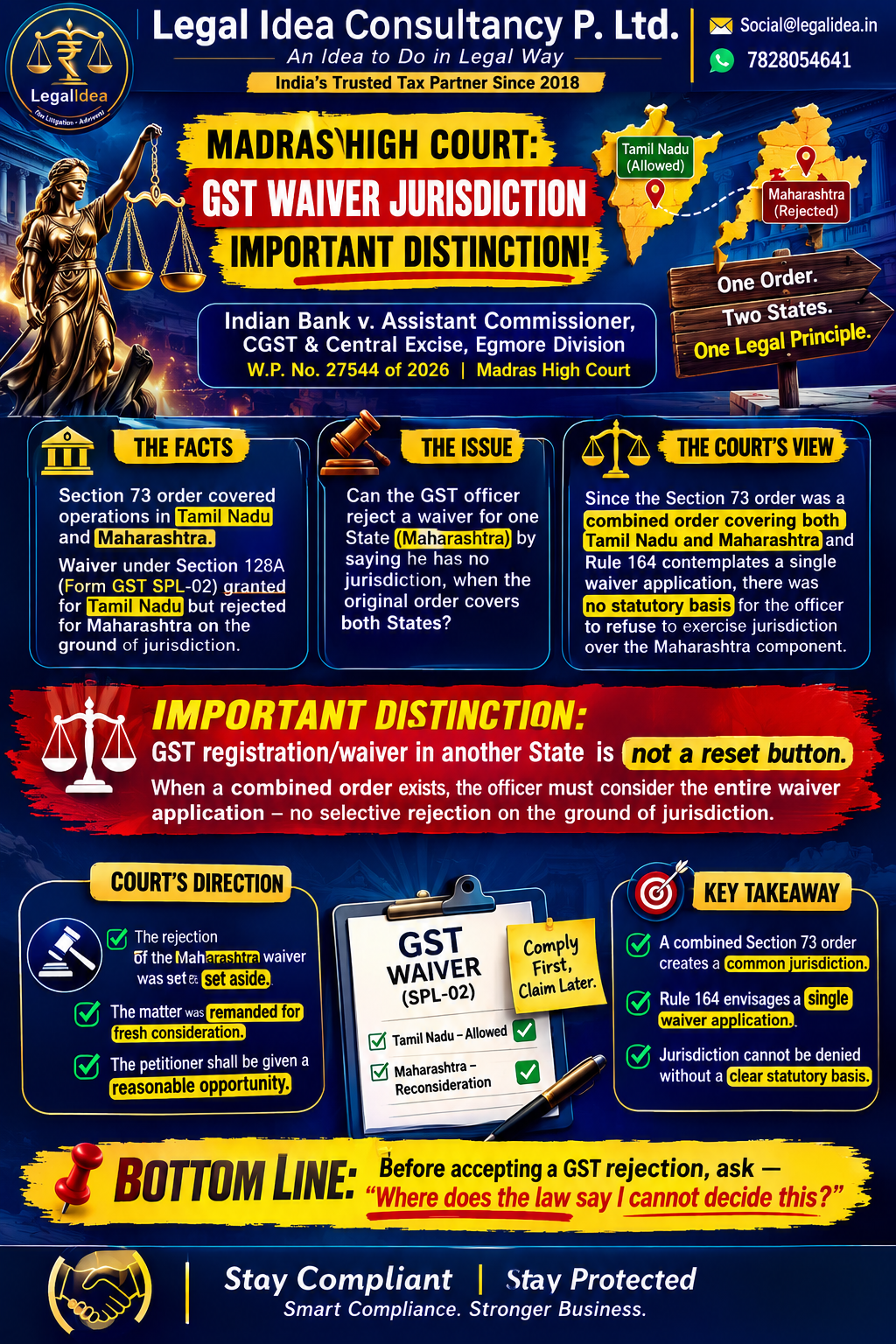
Indian Bank v. Assistant Commissioner, CGST & Central Excise
Madras High Court examines whether a Section 128A waiver application can be partly rejected merely because the officer claims lack of jurisdiction over another State component of a combined Section 73 order.
1. Brief Summary of the Case
The Madras High Court considered whether a GST officer could partly reject a taxpayer's Section 128A waiver application on the ground that the officer did not have jurisdiction to waive interest and penalty relating to another State.
The taxpayer had operations in Tamil Nadu and Maharashtra, and a combined order under Section 73 had been issued covering both locations.
The taxpayer applied for waiver under Section 128A through Form GST SPL-02.
The waiver was granted for Tamil Nadu but rejected for Maharashtra on the ground that the officer was not competent to deal with the Maharashtra component.
The Madras High Court did not accept that position. Since the Section 73 order itself was a combined order covering both Chennai and Maharashtra, the Court found no statutory basis for refusing to exercise jurisdiction over the Maharashtra portion of the waiver application.
2. Court & Bench
🏛️ Court
High Court of Judicature at Madras
⚖️ Judge
Hon'ble Mr. Justice Senthilkumar Ramamoorthy
📅 Date
31 July 2026
📁 Case
W.P. No. 27544 of 2026
W.M.P. Nos. 30177 & 30180 of 2026
3. Petitioner / Respondent
Petitioner
Indian Bank
Represented by its General Manager – Chief Financial Officer.
Respondent
Assistant Commissioner, CGST and Central Excise, Egmore Division, Chennai.
4. What Was the Dispute?
An order under Section 73 had been passed on 21 March 2023 covering the petitioner's operations in:
For the Maharashtra component, the petitioner initially filed an appeal before the Commissioner (Appeals), Mumbai.
That appeal was rejected on 31 January 2024 on the ground that the appellate authority did not have jurisdiction and that the petitioner should approach the authority in Chennai.
The taxpayer then applied for waiver under Section 128A through Form GST SPL-02.
That partial rejection led to the writ petition before the Madras High Court.
5. What Is Important About Section 128A Here?
The taxpayer's waiver application fell within Section 128A(1)(b).
The Court recorded that the tax liability had been discharged before the notified date of 31 March 2025.
The application was originally presented on 26 June 2025, which the Court noted was within the prescribed due date for filing the application.
The application was processed and the waiver was granted for the Tamil Nadu operations.
“Who was competent to consider the Maharashtra portion of the waiver?”
6. Department's Argument
The department relied upon CBIC Circular No. 238/32/2024-GST.
The department argued that the proper officer for considering a Form GST SPL-02 application was the proper officer responsible for recovery under Section 79.
The Court accepted this position to that extent. It noted that both Explanation (b) to Rule 164 and Circular No. 238 supported the proposition that the proper officer for Form GST SPL-02 is connected with the officer contemplated under Section 79.
But that did not end the matter.
7. The Important Question the Court Asked
The Court observed that:
- Section 79 does not itself specify the basis for identifying the proper officer.
- The rules under Chapter XVIII also do not specify that basis.
- Both Sections 79 and 128A use the expression “the proper officer”, indicating a specific officer.
- Rule 164 contemplates one single application in Form GST SPL-01 or SPL-02, rather than multiple applications.
- Section 79 also provides for availing the services of a specified officer for recovery.
8. Important Distinction Made by the Court
But where a combined Section 73 order covers multiple locations and Rule 164 contemplates a single waiver application, a jurisdiction objection requires a clear statutory basis.
The Court did not say that one GSTIN means one officer can decide everything everywhere.
Rather, the issue was the specific structure of the assessment/order and the waiver application.
9. Court's Finding
The High Court found that the rejection of the Maharashtra portion of the waiver application could not be sustained.
What the Court Did
- Partly set aside the impugned order.
- Set aside the rejection relating to Maharashtra.
- Remanded the matter for reconsideration.
10. Did the Court Automatically Grant the Waiver?
The Court did not itself grant the Maharashtra waiver.
Instead, the authority was directed to:
- Reconsider the waiver application for Maharashtra.
- Provide the petitioner a reasonable opportunity.
- Pass a fresh order.
❌ Incorrect headline:
“Madras HC granted Section 128A waiver for Maharashtra.”
✅ Accurate headline:
“Madras HC quashed the rejection of the Maharashtra waiver claim and remanded the matter for fresh consideration.”
11. Judgment / Directions
- ✔️ The rejection relating to Maharashtra was set aside.
- ✔️ The Maharashtra portion of the Section 128A application must be reconsidered.
- ✔️ The taxpayer must be given a reasonable opportunity.
- ✔️ A fresh order must be passed on the Maharashtra waiver claim.
The writ petition was disposed of on these terms. There was no order as to costs.
12. Final Outcome
Indian Bank Won the Jurisdictional Challenge
But the Court did not directly grant the waiver.
Final waiver entitlement: To be decided by the proper officer afresh.
13. Why This Judgment Matters
This judgment is particularly relevant for businesses and institutions with multi-State GST operations.
Suppose one GST dispute covers:
The taxpayer subsequently applies for a statutory waiver through a single Form GST SPL-02.
If the officer grants the waiver for one component but rejects another merely on a jurisdictional objection, this judgment suggests that the officer must have a clear statutory basis for refusing to exercise jurisdiction over the other component.
The Court specifically relied upon the combined nature of the Section 73 order and the fact that Rule 164 contemplates a single application.
14. Practical Compliance Guidance
For businesses considering a Section 128A application, don't stop at: “Tax paid? Yes.”
Build the file around the entire chain:
-
Check the original Section 73 order.
Was it State-specific, GSTIN-specific, or a combined order covering multiple locations? -
Check the tax payment date.
The judgment records that the tax liability here was discharged before 31 March 2025. -
Check the waiver application.
Was the application made in the prescribed form and within the applicable time? -
Check the reason for rejection.
Is the rejection based on eligibility, payment, limitation, documentation, or simply jurisdiction? -
Don't accept a jurisdiction objection blindly.
Ask:“What statutory provision actually prevents this officer from considering this portion of the application?”That is effectively the question the Madras High Court brought into focus.
Key Takeaway
Where a combined Section 73 order covers multiple State operations and Rule 164 contemplates a single Section 128A waiver application, the authority must examine whether it actually has a legal basis to refuse consideration of one State component.
But remember: setting aside the rejection is not the same as granting the waiver. The Maharashtra claim still has to be reconsidered on merits.
Tax Litigation • GST Advisory • Income Tax • Regulatory Compliance
“An Idea to Do in Legal Way”

Comments
2