
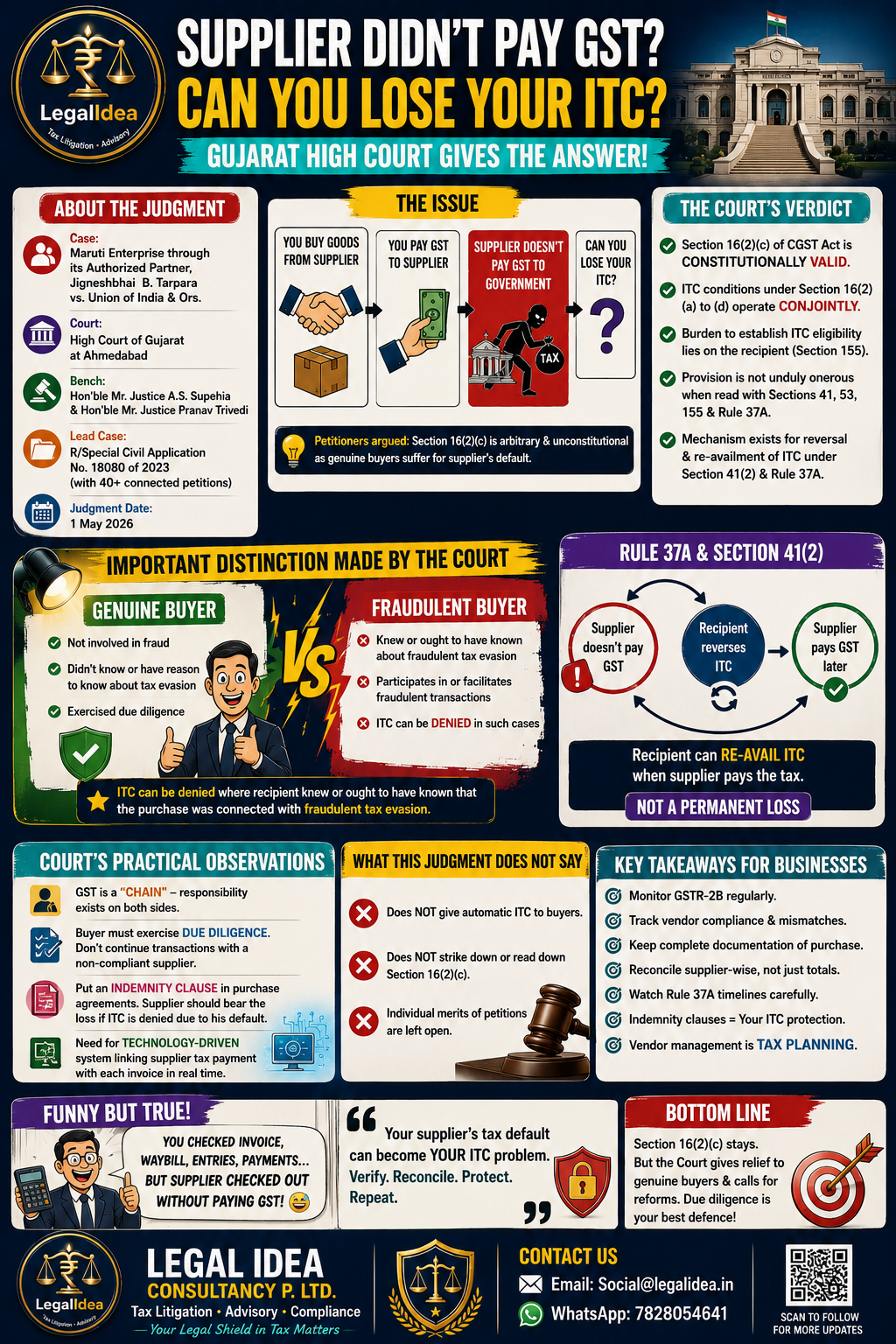
Supplier Didn't Pay GST? Can the Buyer Lose ITC?
Gujarat High Court gives a nuanced answer in Maruti Enterprise v. Union of India & Ors.
⚠️ Important Scope of the Judgment
This is a common judgment dealing with the constitutional validity of Section 16(2)(c) of the CGST Act, with SCA No. 18080 of 2023 as the lead matter.
The Court expressly clarified that the individual merits of the connected petitions were not being decided in this judgment.
Parties
Lead Petitioner
Maruti Enterprise through its Authorized Partner, Jigneshbhai Bharatbhai Tarpara
Respondent
Union of India & Others
Connected Matters
A large batch of connected petitions involving the same legal question.
Facts & Core Issue
Can a genuine buyer lose ITC merely because the supplier failed to pay the GST collected from the buyer to the Government?
Section 16(2)(c) requires that, for ITC eligibility, the tax charged on the supply must actually have been paid to the Government, subject to the statutory framework.
The petitioners argued that this creates a serious problem for genuine purchasers.
🧑⚖️ What Did the Gujarat High Court Hold?
Section 16(2)(c) SURVIVES
- The Court did not strike down Section 16(2)(c).
- The Court did not read down Section 16(2)(c).
- The provision was held to be constitutionally valid.
- It must be read along with the wider GST framework.
The Wider GST Framework Matters
Section 41
The statutory framework for availment and reversal of input tax credit.
Section 53
Considered by the Court while examining the wider statutory architecture.
Section 155
The recipient's burden in establishing eligibility for input tax credit was relevant to the Court's analysis.
Rule 37A
Provides a mechanism for reversal and subsequent re-availment in the circumstances discussed by the Court.
Section 16(2) Conditions — Read Together
The Court held that the conditions under Section 16(2)(a) to (d) operate conjointly.
Therefore, ITC eligibility does not end merely at:
“Goods received.”
The recipient must establish eligibility up to the requirement contained in clause (c), along with the other statutory conditions.
🔥 The Important Distinction
SECTION 16(2)(c) SURVIVES — BUT BONA FIDE BUYERS ARE NOT TO BE TREATED LIKE FRAUDSTERS.
The Court recognised the need for a balanced approach between genuine purchasers and purchasers involved in fraudulent transactions.
🟢 Genuine Purchaser
- Purchases goods genuinely.
- Pays GST to the supplier.
- Receives the goods.
- Maintains proper documentation.
- Not involved in fraudulent tax evasion.
🔴 Fraudulent / Knowing Participant
- Knows or ought to know about fraudulent conduct.
- Participates in a fraudulent transaction.
- Perpetuates a broken credit chain despite knowledge.
- Fails to exercise required due diligence.
⚠️ Don't Misread the Judgment
Bona Fide Does Not Mean Automatic ITC
The judgment does not say that a buyer gets automatic ITC merely because the buyer claims to be bona fide.
Section 16(2)(c) remains valid. The recipient still has to satisfy the statutory conditions and discharge the burden contemplated by Section 155.
🔄 What About Rule 37A?
Supplier doesn't pay → Recipient reverses ITC → Supplier subsequently pays → Recipient can re-avail ITC.
The Court gave considerable importance to the statutory mechanism under Section 41(2) and Rule 37A.
According to the framework discussed in the judgment, the purchaser is not necessarily permanently deprived of the credit merely because of the supplier's default.
The judgment also records the Rule 37A conditions, including situations where the supplier has not deposited the tax and has not filed the corresponding GSTR-3B.
🔍 Court's View on Due Diligence
Supplier's Duty
The supplier has responsibility for compliance within the GST tax chain.
Buyer's Duty
The buyer is also expected to exercise due diligence.
Once Non-Compliance Is Known
A buyer should not blindly continue transactions that perpetuate a broken credit chain.
📝 Practical Contract Solution
Put a GST Indemnity Clause in the Purchase Agreement.
If supplier default results in ITC loss, the commercial contract can address who bears the resulting financial loss.
This turns the issue from only a tax litigation problem into contract drafting + vendor risk management + tax compliance planning.
⚖️ Judgment / Directions
Not Struck Down
Section 16(2)(c) was not declared unconstitutional.
Not Read Down
The Court declined to read down the provision.
Constitutionally Valid
Section 16(2)(c) was held constitutionally valid.
Wider Framework
The provision must be considered with the wider GST framework.
Reversal / Re-availment
The statutory mechanism under Section 41 and Rule 37A was recognised.
Individual Merits Open
The individual merits of the connected petitions were left open for decision.
🎯 Final Outcome
SECTION 16(2)(c) SURVIVES.
- The constitutional challenge failed.
- The statutory condition remains in force.
- The genuine purchaser concern remains a significant practical issue.
- The Court recognised the need for legislative clarification and a technology-driven mechanism.
- Connected petitions were to be listed for decision on their individual merits.
The statutory condition stays. The bona fide purchaser problem remains very real.
The Court suggested legislative clarification and a technology-driven mechanism capable of linking supplier tax payment with specific invoices in real time.
Your supplier's GST compliance can affect your ITC.
🚨 Future Planning for Clients
Check GSTR-2B Regularly
Don't wait until annual reconciliation to identify supplier-side issues.
Monitor Vendor Compliance
Repeated mismatch or non-compliance should trigger a vendor review.
Maintain Complete Purchase Documentation
Invoice + e-way bill + GRN + payment proof + purchase order + correspondence.
Reconcile Supplier-Wise
Don't only look at total ITC. Track the supplier and transaction trail.
Watch Rule 37A
ITC reversal and re-availment should be monitored systematically.
Add GST Indemnity Clauses
Address responsibility for ITC loss caused by supplier default.
Maintain Vendor Due Diligence
Build a documented process for reviewing supplier compliance and transaction risk.
Don't Ignore Known Risk
Once supplier non-compliance becomes known, don't blindly continue transactions with the same risk.
Vendor management is now part of tax planning.
The GST credit chain doesn't stop at your purchase invoice. Your supplier's compliance can become part of your ITC risk.
High Court of Gujarat at Ahmedabad | R/Special Civil Application No. 18080 of 2023 | Judgment pronounced on 1 May 2026
Prepared for tax and legal awareness purposes. The judgment concerns the constitutional validity of Section 16(2)(c) and the wider statutory framework. Individual connected matters were left open for decision on their respective merits.

Comments
2