
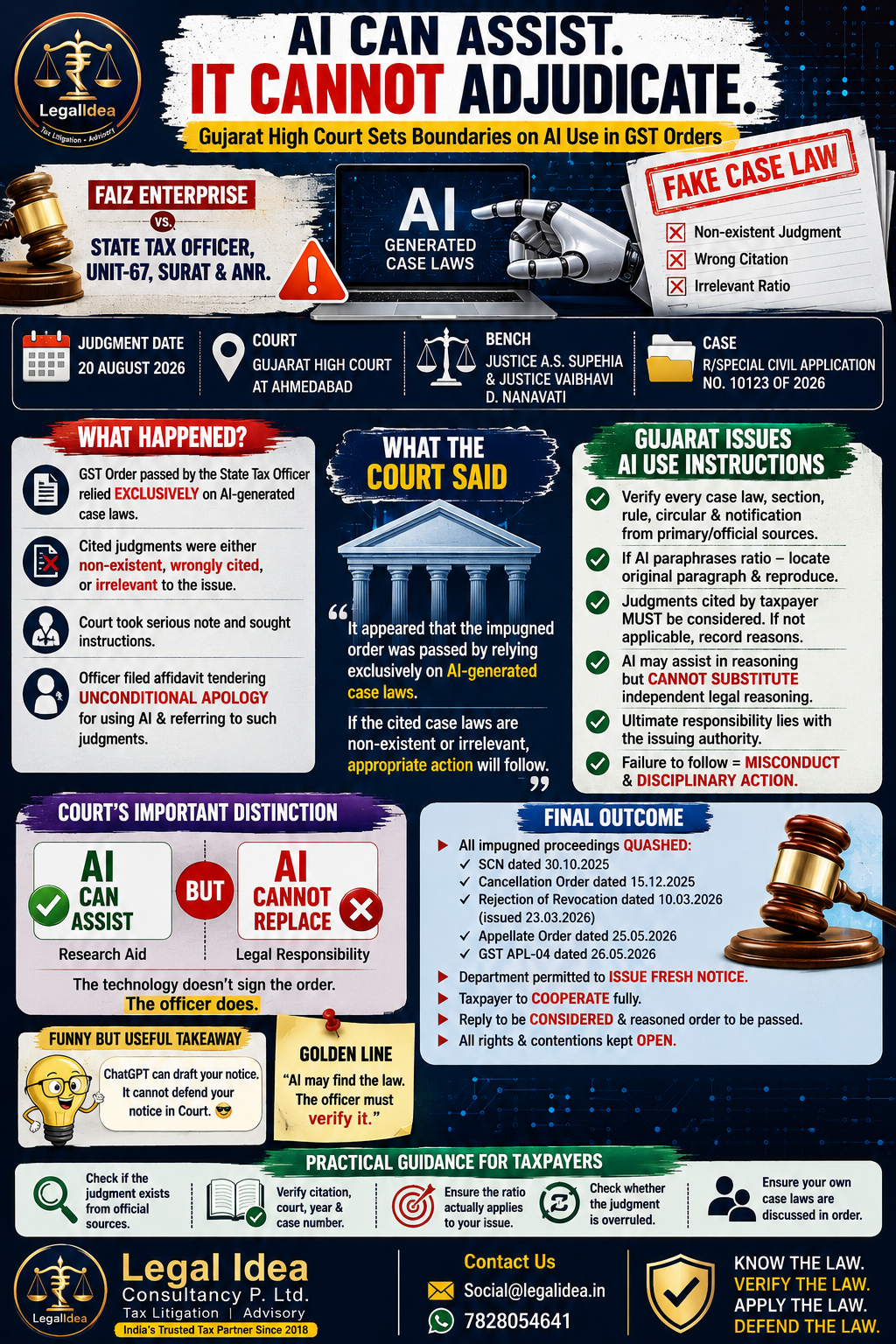
Faiz Enterprise v. State Tax Officer, Unit-67, Surat & Anr.
Gujarat High Court examines the use of Artificial Intelligence in GST adjudication after non-existent and irrelevant case laws were relied upon in an order.
1. Brief Summary of the Case
The Gujarat High Court considered a GST cancellation dispute where the taxpayer challenged an order passed by the State Tax Officer.
During the proceedings, the taxpayer pointed out something much more serious than an ordinary legal error:
The GST officer had relied upon case laws generated/referred through Artificial Intelligence, including authorities that:
- did not exist;
- had incorrect citations; or
- did not deal with the issue involved in the taxpayer's case.
The High Court initially took serious note of this and directed the department to obtain instructions.
The officer subsequently filed an affidavit and tendered an unconditional apology, admitting that AI had been used in drafting the order and that non-existent and irrelevant judgments had been referred to.
The Court then directed that the department's new AI-use instructions must be scrupulously followed and ultimately quashed the impugned GST proceedings, permitting the department to issue a fresh notice.
2. Court & Bench
🏛️ Court
High Court of Gujarat at Ahmedabad
⚖️ Bench
Hon'ble Mr. Justice A.S. Supehia
Hon'ble Ms. Justice Vaibhavi D. Nanavati
📅 Date
20 August 2026
📌 Neutral Citation
2026:GUJHC:53490-DB
Approved for reporting
3. Case Number
R/Special Civil Application No. 10123 of 2026
Petitioner:
Faiz Enterprise, through proprietor Mahetar Mahir Farukbhai
Respondents:
State Tax Officer, Unit-67, Surat & Anr.
4. What Started the Dispute?
The taxpayer challenged GST proceedings relating to cancellation of its GST registration.
30 Oct 2025
Show Cause Notice
15 Dec 2025
Cancellation Order
10 Mar / 23 Mar 2026
Rejection of Revocation Application
25–26 May 2026
Appellate Order / GST APL-04
The taxpayer approached the Gujarat High Court challenging these proceedings.
But the case became much bigger than a normal GST cancellation dispute.
5. The AI Problem
The taxpayer's advocate pointed out that the State Tax Officer had relied upon several judgments which allegedly did not stand up to basic verification.
The Court recorded allegations concerning judgments that were allegedly non-existent, incorrectly cited or irrelevant to the proposition for which they were relied upon.
State of Gujarat v. Aarbee Structures Pvt. Ltd.
The petitioner submitted that the cited judgment was not in existence.
M/s Sri Vinayaga Agencies v. Assistant Commissioner
The petitioner submitted that the citation was different and that the ratio relied upon did not apply.
Jyoti Tar Products Pvt. Ltd. v. Deputy Commissioner
The petitioner submitted that neither the citation nor the ratio matched the proposition for which it had been cited.
Turning Point
The Court observed that it appeared the impugned order had been passed by relying exclusively on AI-generated case laws.
6. Court's Initial Reaction
The Court took the issue seriously and directed the learned AGP to obtain appropriate instructions.
The Court also stated that if the petitioner's allegations were found correct — particularly if the cited judgments were non-existent or completely irrelevant — the Court could:
- require the concerned officer to appear; and
- initiate appropriate action against the officer.
AI-generated legal authorities cannot simply be inserted into a quasi-judicial order without verification.
7. What Did the Officer Say?
The concerned State Tax Officer filed an affidavit and tendered an:
The affidavit specifically stated that:
- he was a probationary officer;
- the mistake occurred due to lack of experience;
- AI was used in drafting the order;
- non-existent and irrelevant judgments were referred to; and
- he subsequently attended training concerning the use of AI in drafting and adjudication/appellate orders.
8. The Bigger Development: Gujarat Issues AI Instructions
Following the Court's intervention, the Additional Commissioner of State Tax, Gujarat issued instructions dated 18 August 2026 concerning the use of AI by adjudicating and quasi-judicial authorities.
The stated purpose was to ensure that orders remain:
Sustainable
Accurate
Defensible
The Gujarat High Court incorporated these instructions into its order and directed that they be scrupulously followed.
9. The Court's Most Important Distinction
The instructions specifically require that any:
Case Law
Must be independently verified.
Statutory Provision
Must be checked against the primary source.
Rule / Circular
Must be independently verified.
Notification
Must be checked before incorporation into the order.
The officer must verify the law.
If AI paraphrases a judgment's ratio, the officer must locate the original paragraph before relying upon it.
10. What About Judgments Cited by the Taxpayer?
The instructions also specifically protect this side of adjudication.
Taxpayer's Case Law Must Be Considered
- ✔️ Where the taxpayer cites a judgment, the adjudicating authority must consider it.
- ✔️ If the authority believes that the judgment does not apply, reasons for rejecting its applicability must be given.
A taxpayer's case law cannot simply disappear from an adjudication order without discussion.
11. AI Must Have Human Oversight
The instructions go further. Where AI, open-source tools or other technological tools are used, such use must be accompanied by:
The instructions expressly acknowledge concerns relating to:
- accuracy;
- transparency; and
- unknown underlying information.
BUT CANNOT SUBSTITUTE IT.
The order must reflect:
- independent legal reasoning;
- application of mind to the facts; and
- application of mind to the law.
12. Ultimate Responsibility Remains With the Officer
THE OFFICER DOES.
The instructions expressly state that the ultimate responsibility for correctness of the order lies with the issuing authority, irrespective of the technological tools used.
Failure to follow the instructions, including passing orders based on unverified AI content, may amount to:
and may attract disciplinary action.
13. What Happened to the Taxpayer's GST Proceedings?
The learned AGP stated that the respondents intended to revise the impugned orders by resorting to Section 108 of the GST Act and that a fresh order could be passed, with the possibility of issuing a fresh show cause notice.
The Court quashed and set aside:
- Show Cause Notice dated 30.10.2025
- Cancellation Order dated 15.12.2025
- Rejection of revocation application dated 10.03.2026 / issued 23.03.2026
- Appellate Order dated 25.05.2026
- GST APL-04 dated 26.05.2026
14. Did the Court Declare the Taxpayer Completely Right?
The Court did not hold that the taxpayer was permanently free from GST proceedings.
Instead, the department was permitted to:
The taxpayer was directed to fully cooperate with the proceedings. Its reply and defence must be duly considered and the authority must pass a reasoned order in accordance with law.
All rights and contentions of both sides were kept open.
❌ Not the correct takeaway:
“AI was used, therefore the taxpayer won the GST case forever.”
✅ Correct takeaway:
“The impugned proceedings were quashed, and the department was permitted to restart the matter through a fresh notice and legally sustainable adjudication.”
15. Final Outcome
Existing GST proceedings — QUASHED
Fresh Proceedings — PERMITTED
AI-assisted research — ALLOWED
Verification + Human Oversight + Independent Legal Reasoning
Key Takeaway for Tax Professionals
AI is a tool. It is not the adjudicator.
The Faiz Enterprise judgment sends a strong message for the future of AI-assisted tax administration.
AI can help research.
AI can help organise.
AI can help draft.
But every authority, citation, statutory provision and proposition must be independently verified.
The final order must show the officer's own application of mind.
“AI output may assist in reasoning — but cannot substitute reasoning.”
Tax Litigation • GST Advisory • Income Tax • Regulatory Compliance
“An Idea to Do in Legal Way”

Comments
2