
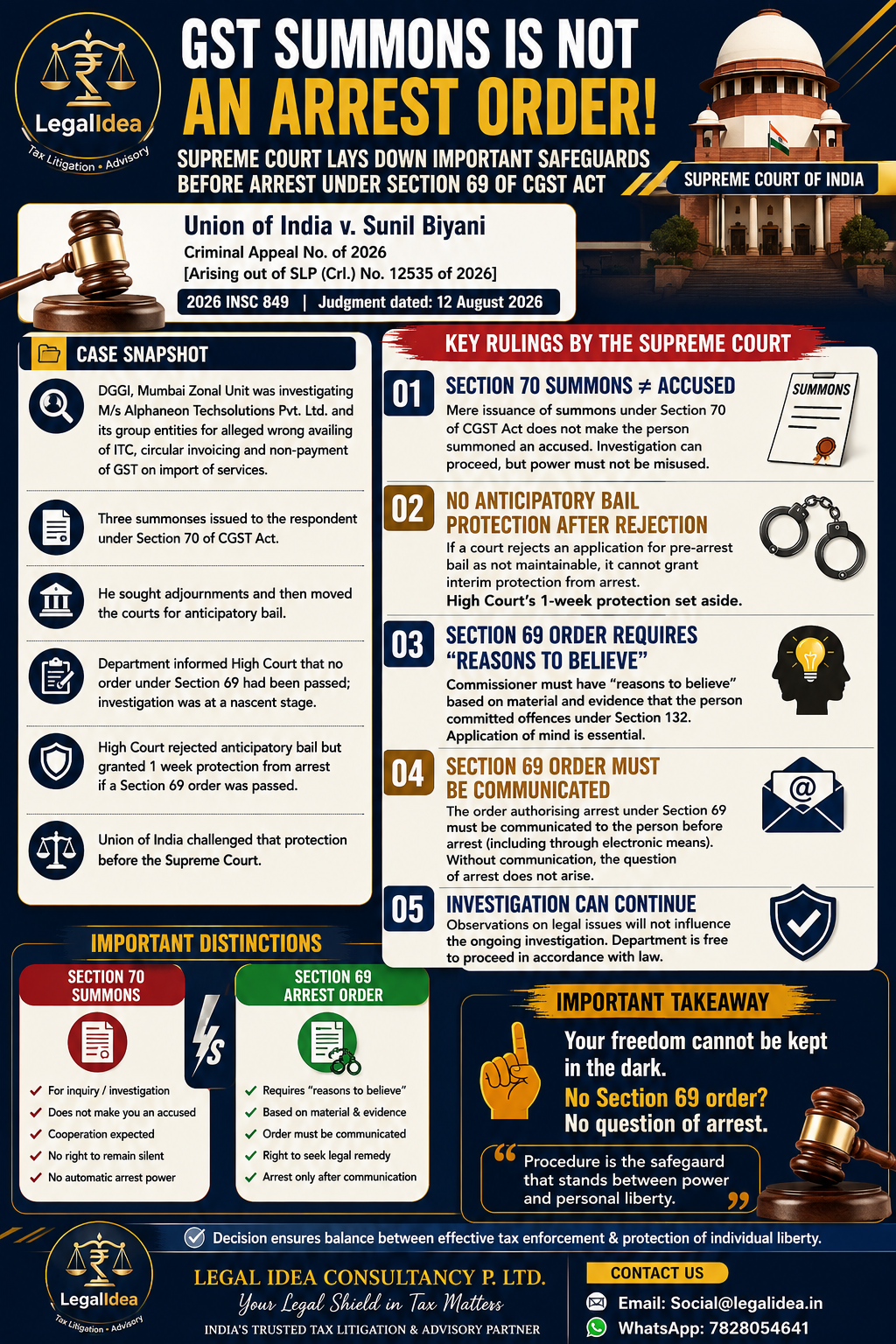
Union of India v. Sunil Biyani
A significant Supreme Court ruling on Section 70 summons, Section 69 arrest authorisation, “reasons to believe” and communication of an arrest order before arrest.
Justice Sheel Nagu
Brief Summary
The Supreme Court examined the legal consequences of GST summons issued under Section 70 and the procedural safeguards surrounding arrest under Section 69 of the CGST Act.
The immediate dispute arose after the High Court rejected an anticipatory bail application but nevertheless granted one week's protection from arrest if a Section 69 arrest order was subsequently passed.
The Supreme Court set aside that protection and simultaneously clarified an important safeguard: a Section 69 arrest authorisation must be communicated to the person sought to be arrested before arrest.
Background
DGGI Investigation
The DGGI, Mumbai Zonal Unit was investigating M/s Alphaneon Techsolutions Pvt. Ltd. and its group entities.
Section 70 Summonses
Three summonses were issued to Sunil Biyani during the investigation.
Instead of appearing, he sought adjournments and subsequently approached the courts seeking pre-arrest / anticipatory bail.
How the Dispute Reached the Supreme Court
DGGI investigation begins
Investigation into alleged wrongful ITC, circular invoicing and GST implications relating to import of services.
Three summonses issued
Sunil Biyani was summoned to appear before the investigating authority.
Anticipatory bail rejected
The High Court noted that no Section 69 arrest order had yet been passed.
One-week protection granted
Despite rejecting the application, the High Court granted protection from arrest if a Section 69 order was subsequently passed.
Union of India challenges protection
The Union of India challenged the one-week protection before the Supreme Court.
What Did the High Court Do?
The High Court rejected the anticipatory bail application because there was no Section 69 arrest order at that stage.
What Did the Supreme Court Hold?
Section 70 Summons ≠ Accused
Mere issuance of a summons under Section 70 does not make the summoned person an accused.
Investigation can proceed, but statutory powers cannot be misused.
No Bail Protection After Rejection
Where a court rejects a pre-arrest bail application because the relief is not maintainable, it cannot simultaneously grant interim protection from arrest.
Section 69 Requires “Reasons to Believe”
The Commissioner must have reasons to believe that the person committed specified offences under Section 132.
Reasons Must Show Application of Mind
The reasons must refer to the material and evidence forming the basis of the Commissioner's opinion.
Section 69 Order Must Be Communicated
The arrest authorisation must be communicated to the person sought to be arrested before arrest.
Electronic Communication Is Permissible
The Court directed that communication may also take place through electronic means, where appropriate.
Section 69: Arrest Authorisation Cannot Remain Hidden
The Supreme Court examined whether the Section 69 arrest order must be communicated to the person sought to be arrested.
The Court answered in the affirmative.
Reasons to Believe
Commissioner must form the statutory opinion required under Section 69.
Material & Evidence
The reasons must be based on relevant material and evidence.
Application of Mind
The order must demonstrate proper application of mind.
Communication Before Arrest
The Section 69 order must be communicated to the person before arrest. This enables the person to seek an appropriate pre-arrest remedy.
Why Did the Court Insist on Communication?
If the Section 69 order is never communicated, the person may not even know that the Commissioner has authorised arrest.
That can create a catch-22 situation: the person needs to know about the arrest authorisation to seek an appropriate pre-arrest remedy, but cannot effectively seek that remedy if the authorisation remains undisclosed.
Arrest Order
to Person
Legal Remedy
Section 70 vs Section 69
Summons
Investigation mechanism under the CGST Act.
- 📌 Summons to appear / give evidence
- 📌 Does not by itself make person an accused
- 📌 Investigation may continue
- 📌 Not itself an arrest order
Arrest
Statutory power of arrest exercised by the Commissioner.
- ⚠️ Requires “reasons to believe”
- ⚠️ Reasons must be based on material and evidence
- ⚠️ Application of mind is required
- ⚠️ Order must be communicated before arrest
Final Outcome
The Supreme Court set aside the one-week protection from arrest.
Mere issuance of summons does not make the summoned person an accused.
Arrest authorisation requires reasons to believe based on material and evidence.
The Section 69 order must be communicated to the person sought to be arrested.
Communication may be made electronically where appropriate.
The investigation can continue uninfluenced by the observations on the legal issue.
Practical Takeaway for GST Practitioners
This judgment draws a clear line between the investigative power under Section 70 and the arrest power under Section 69.
A person receiving a GST summons should not automatically assume that arrest has been authorised.
At the same time, if the Commissioner authorises arrest under Section 69, the order cannot simply remain undisclosed. The statutory “reasons to believe”, supporting material, application of mind and communication of the order become critical safeguards.
“A GST summons is not an arrest order. And an arrest order under Section 69 cannot remain hidden from the person it targets.”
Union of India v. Sunil Biyani — 2026 INSC 849
Comments
2